Kora Around Kailash:
With a Guide or Independently in 2026

1. Introduction to the Kora Around Kailash

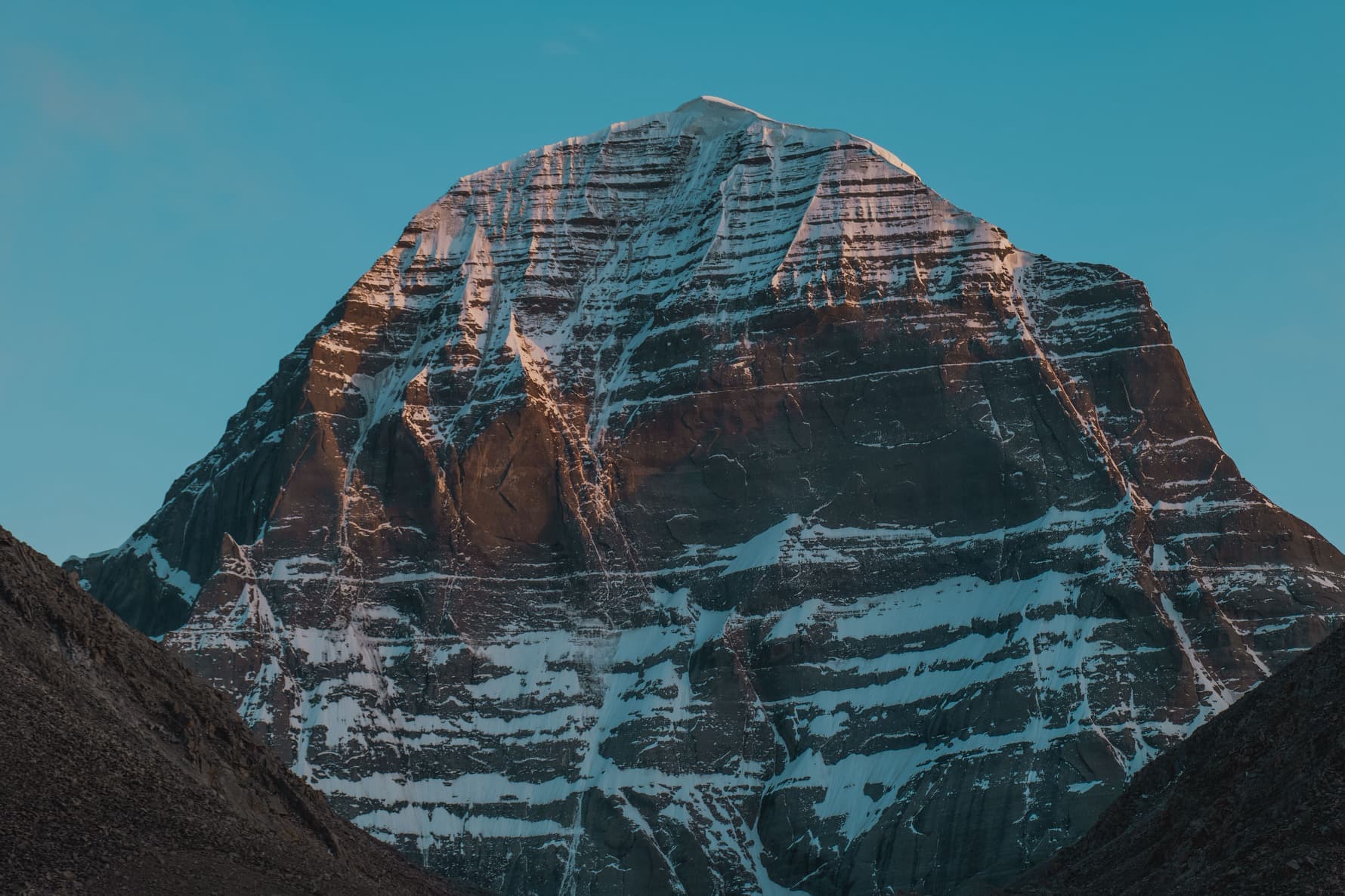
Kailash stands at an altitude of 6,638 meters — a four-sided pyramid on the Tibetan Plateau. For Buddhists, Hindus, Jains, and Bon followers, it is the axis of the world, the center of the cosmos. Every year, thousands of pilgrims come here to perform the kora — a circumambulation of the mountain in a clockwise direction, which traditionally washes away the karmic debts of a lifetime.
52 kilometers over three days is not just a route. It is an inner journey: stones beneath your feet where prayers have been left, the sky above so deep that even without the altitude, it takes your breath away. The silence here is dense, almost physical. As you walk, you think little — your body is occupied with the altitude, while your consciousness gradually becomes liberated.
Honestly, the main question everyone has is: should you go with a guide or go solo?
Kora with a Guide
An experienced guide removes dozens of small but critical decisions from your shoulders. At altitudes above 4,500 meters, even the choice of pace is a delicate matter: too fast, and you risk high-altitude pulmonary edema; too slow, and the group will leave you behind, and you'll be without support. The guide knows when to stop, where it is safe to spend the night, and how to read the weather from the clouds over the Dolma La Pass.
If it is your first time in the Himalayas, or if heights above 3,000 meters are terra incognita for you, the group option provides peace of mind. In our program from Lhasa, we include acclimatization days, meetings with lamas, and rituals at the foot of the mountain — you won't just complete the circle, you'll enter the context. Plus, in a group, it’s easier to get through tough sections: when you see that your neighbor is also gasping for breath on the ascent to Dolma La, it becomes easier.
Independent Kora
If you have experience with high-altitude hiking, navigation skills, and a desire to meet Kailash one-on-one, an independent route can be a revelation. Without a group, you can choose your own rhythm, stop at any stupa, and sit on a rock for as long as you want, watching the light change on the northern face.
But keep in mind: at an altitude of 5,600 (Dolma La pass), the weather can turn in half an hour — sunny in the morning, and a snowstorm by noon. You need to work out the forecast in advance, take a GPS track, stock up on water and calories. You should have a first-aid kit with Diamox (for altitude sickness prevention), a thermos, a satellite phone or tracker — mobile communication there is elusive.
The choice depends on what matters more to you: immersion in tradition and safety or freedom and the opportunity to establish your own dialogue with the mountain. Both paths are valid. If you want to combine structure with depth, check out the route through Nepal with Gosainkunda — there are fewer tourists and more time for inner work.
In any case, the kora will stay with you forever. Not as a memory, but as an experience woven into your being.
2. Preparing for the Journey

Checklist for an Independent Hike
If you've decided to go alone, here's what you'll really need (no fluff, just proven essentials):
Gear:
-
Trekking boots — waterproof, with a stiff sole and ankle support. Break them in beforehand; blisters at altitude heal poorly.
-
Sleeping bag rated for at least -15°C (it can drop to -10°C at the pass, even in summer).
-
Tent — lightweight, wind-resistant; if you’re going with 2-3 people, one tent can be shared.
-
Backpack 60-70 liters — a comfortable suspension system is critical; you’ll be carrying it yourself.
-
GPS navigator or offline maps (maps.me, Gaia GPS) with the kora track downloaded.
-
Gas stove + canister, pot, spoon-bowl. At altitude, water boils at 85°C — keep this in mind when cooking porridge.
-
First-aid kit: Diamox (altitude sickness prevention), pain reliever, bandage, adhesive plaster, activated charcoal, anti-diarrheal medication, sunscreen SPF 50+.
-
Food: dehydrated meals, nuts, dried fruits, energy bars. Plan for 3,000–3,500 calories per day — you expend more at altitude.
Documents:
-
Passport, Chinese visa (for Tibet — a special permit, arranged through a travel agency, cannot be obtained independently).
-
Tibet Travel Permit, Alien's Travel Permit — without them, you'll be turned back at checkpoints.
-
Medical insurance covering heights up to 6,000 meters and helicopter evacuation. Standard policies do not cover high-altitude trips — check the fine print.
Physical Preparation:
Start 3-4 months in advance. Cardio (running, cycling, swimming) 3-4 times a week, strength training — squats, planks, stair climbing with a backpack. A month before the trip, do a few one-day hikes in the mountains with an altitude gain of 800–1,000 meters — this will help you understand how your body reacts to the load and thin air.
Tips for Choosing Guides and Tours
If you trust the route to professionals, here’s what to look for:
Reputation:
Look for genuine reviews — not on the company website, but in independent groups, on forums (for example, Tonkosti Turizma, Mountain.RU). Ask for specifics: how did the guide act in a difficult situation, was there support at altitude.
Experience:
Clarify how many times the guide has led groups specifically to Kailash (not "in the Himalayas in general"). Ask questions: how does he deal with altitude sickness symptoms, does he have a wilderness first aid certification, is he familiar with local rituals — this is part of the experience, not just technique.
Group Size:
The optimal size is 6-8 people. In larger groups (12+), the guide physically cannot pay attention to everyone; in smaller groups (2-3), the cost per person is higher, but there is more flexibility.
Program:
Check how many days are allocated for acclimatization. If you’re taken straight to 4,500 meters without stops in Lhasa (3,650 m) and Shigatse (3,800 m) — that’s risky. A good program includes at least 3-4 days of gradual altitude gain before the kora.
Check out our route from Lhasa — everything is well thought out in terms of acclimatization, plus meetings with practitioners, not just a "tick in the passport."
Recommendations for Acclimatization and Safety
Acclimatization is not a whim; it’s physiology:
-
Ascend slowly: no more than 300–500 meters of altitude gain per day after 3,000 m.
-
"Climb high, sleep low": if you reach 4,500 during the day, it's better to sleep at 4,200.
-
Drink 3-4 liters of water a day. Dehydration exacerbates altitude sickness.
-
Avoid alcohol and sleeping pills — they suppress breathing, which is dangerous at altitude.
Symptoms of Altitude Sickness (watch yourself and your companions):
-
Mild: headache, nausea, weakness, insomnia. Stopping, resting, drinking plenty of fluids, and Diamox can help.
-
Severe: confusion, loss of coordination, coughing with pink froth (pulmonary edema) — immediate descent is necessary; this is a life-threatening condition.
Safety:
-
Always inform someone of your route and return time. If you’re going alone, activate the SOS function on your GPS tracker (Garmin inReach, SPOT).
-
Carry a whistle, headlamp, spare batteries. In bad weather, visibility can drop to 5 meters — it's easy to get lost.
-
Don’t be a hero. If you feel your body can’t cope, turn back. Kailash isn’t going anywhere; you can return later.
In practice, we always carry oxygen, a pulse oximeter (measures blood saturation), and a comprehensive first-aid kit in our groups. This is not over-caution — it’s respect for the mountain and for the people who have entrusted you.
3. Route Options

The kora around Kailash is a classic, but there are several approaches to it. Let’s break down the main ones and help you choose the one that’s right for you.
Popular Routes Around Kailash
1. Classic Kora (outer, clockwise):
-
Length: 52 km
-
Time: 3 days (sometimes 2, if you are physically prepared)
-
Start/Finish: Darchen (4,560 m)
-
Highest Point: Dolma La Pass (5,630 m)
The first day features a gentle ascent through the La-Chu Valley to the Dirapuk Monastery (5,210 m). The views of Kailash's northern face are the ones you see on all postcards. The second day is the toughest: the ascent to Dolma La, descent to Lake Gaurikund, and overnight at Zutulpuk (4,790 m). The third day is a calm return to Darchen. Along the route, you’ll encounter stupas, pilgrims stretching out, Tibetan families with children — the atmosphere is dense and alive.
2. Kora via Nepal (Simikot — Kailash route):
-
Kora Length: the same, 52 km, but includes an approach through Nepal (10-12 days total trek)
-
Feature: fewer tourists, more time for adaptation, sacred Lake Manasarovar along the way, and the possibility of combining with a trek to Gosainkunda.
This option is for those who want to "approach" Kailash from a distance, through passes and villages where life continues as it did 500 years ago. Physically a bit easier — the altitude gain is gradual, and by the time of the kora, you’ll be acclimatized. Plus, the Nepali part gives you time to tune in internally, without haste. Our route through Nepal with Gosainkunda is built this way.
Comparison of Routes
-
Difficulty Level: -
-
Independently (classic kora): If you have experience in high altitudes (Elbrus, Kilimanjaro, or at least Nepal up to 5000 m), the route is technically not difficult — the path is well-trodden, and it's hard to get lost. However, altitude and weather can take down even the experienced. Discipline is needed: don’t rush, listen to your body, and stop in time.
-
With a guide: Suitable for those who are hiking for the first time or don’t want to take risks. The guide controls the pace, knows where it's safe to spend the night, and assists with symptoms of altitude sickness. Being in a group is easier psychologically — when it gets tough, you see that others are struggling too, which gives you strength. In our program from Lhasa, we lead the group in a way that everyone reaches the finish — without heroics, but also without leniency.
Attractions:
-
On the classic kora: Chuku Monastery, Dira-Puk (the cave where Milarepa meditated), Gaurikund Lake at Dolma-La (pilgrims even dip into the icy water), the southern wall of Kailash at sunset — it's simply cosmic.
-
Through Nepal: Manasarovar Lake (one of the holiest in Asia, the circumambulation around it is a separate kora), Chiu Gompa monastery on the shore, encounters with Nepalese Sherpas and Tibetan nomads — the cultural layer is richer.
Recommendations for Choosing a Route
Realistically assess your experience:
If you've only been in the mountains in Crimea or the Carpathians — start with an organized tour. Kailash is not a place for experimentation.
Consider why you are going:
If the goal is just to tick off a box, to rush through in 2 days — honestly, it’s not worth it. If you want to experience something greater, allow time, and go with those who understand this as well.
Study reviews of specific guides:
Not companies — individuals. How do they behave in critical situations, how flexible are they, can they listen to the group?
Plan with a buffer:
If your vacation is tight — it's better to postpone. Kailash requires time: for the journey, acclimatization, the kora itself, and possibly an extra day of rest if the weather turns bad.
Any of the routes will leave a mark. Choose one that offers not only a physical challenge but also space for inner reflection.
4. Logistics and Budget

The kora around Kailash is a serious journey, and the budget here is not a formality. Let’s break down the real figures for 2026 and what exactly the money is spent on.
Overview of Costs: Independently vs. With a Guide
Independent travel:
On paper, it seems cheaper, but in practice, it’s more complicated. The minimum budget is from $800 to $1200 per person, but that’s if everything goes smoothly.
-
Visa and permits: Tibet Travel Permit + Alien's Travel Permit — about $150–200 (they can only be obtained through agencies, you cannot get them on your own).
-
Transport: Flight Kathmandu/Lhasa — Ali (the nearest airport to Darchen) from $300, or a land transfer (2–3 days by jeep) — $400–600.
-
Accommodation: Guesthouses in Darchen $10–20/night, on the route — tent (your own) or overnight stay at monastery guesthouses ($5–10, but spots are not always available).
-
Food: $10–15/day (if you cook for yourself) or $20–30 (if in tea houses on the route — the selection is limited, prices are inflated due to remoteness).
-
Insurance: Good insurance, covering heights up to 6000 m and evacuation, — $80–150.
Hidden costs:
Rental of satellite phone/tracker ($50–100), unexpected delays due to weather (extra days of accommodation), medications. Plus the nerves: independently arranging permits, finding transport, negotiating with drivers — it takes time and energy that could be spent on preparation.
Traveling with a guide:
The price is higher — from $1400 to $2200, but almost everything is included:
-
All permits and visa support.
-
Transport: transfers, jeeps in Tibet, including the road to Darchen and back.
-
Accommodation: guesthouses, hotels in Lhasa/Shigatse, on the route — tents or monastery shelters (the guide knows where there are guaranteed spots).
-
Food: three meals a day, on the route — prepared by accompanying staff.
-
Guide, support team (porters/yaks for equipment, if needed).
-
Insurance is often included or arranged through the operator.
Honestly, the difference of $400–600 is worth it. You arrive, gear is provided, the route is explained, and then — just walk. All logistics are taken care of by a team that has been guiding groups for years.
Important Aspects: Transport, Food, Accommodation
Transport:
Getting to Darchen is a quest. There are no direct flights, only through Lhasa or Kathmandu, then — jeep (10–12 hours on mountain serpentine roads) or an internal flight to Ali + 4 hours by land. If you are traveling independently, you'll need to find fellow travelers to share the jeep rental ($500–700 per vehicle). With a guide, this is arranged in advance.
Food:
On the kora route — minimal infrastructure. There are tea houses, but the menu is the same: noodles, rice, and sometimes tsampa (barley flour). Prices are 2–3 times higher than in the valley. If you go independently, take dehydrated meals, nuts, chocolate — calorie-dense and lightweight. In a group, cooks prepare hot soup, porridge, tea — a lifesaver at altitude.
Accommodation:
In Darchen — simple guesthouses, without hot water (or with water only a few hours in the evening). On the kora: Dira-Puk and Zutul-Puk — monastery shelters, where you can rent a mattress in a common room ($5–10) or pitch a tent nearby. If you're going independently — a tent is more reliable, as spots in shelters may not be available. In organized tours, accommodation is booked in advance.
Budget Management Recommendations
Compare all options before booking:
Calculate not only the base cost but also insurance, visas, unexpected expenses. Often, a "cheap" independent route turns out to be more expensive in reality.
Book in advance (4–6 months):
Flights are cheaper, as are tours. Plus, you have more time to prepare physically.
Set aside a reserve of 10–15% of the budget:
At altitude, anything can happen: the weather may close the pass, and you may have to wait a day or two; if you feel unwell — you’ll need medications or an additional day for rest. It’s better to return with a surplus than to get stuck without funds.
Insurance — don’t skimp:
Cheap policies don’t cover high altitudes and evacuation. If you experience pulmonary edema (which is real at 5600 meters), a helicopter ride will cost $5000–10000 without insurance. Get specialized coverage: World Nomads, ERGO, “Arsenal” with high altitude option.
Food on the route:
If you go independently — stock up in Lhasa (it’s cheaper and has a wider selection); there’s almost nothing in Darchen. The caloric intake should be at least 3000 kcal/day.
If you want clarity and peace of mind — check out our programs. For example, Kailash: Sacred Kora from Lhasa — everything is transparent, with no hidden fees, and you know in advance what you’re paying for.
Kailash is a place to focus on the inner journey, not on where to find accommodation or how to catch a jeep.
5. Travelers' Experiences

The kora is experienced differently. Some return feeling they have encountered something greater than the mountain. Others realize they overestimated their strength. I share stories from people who walked with us and independently, without embellishment.
Traveler Stories
Anna, 38, designer from St. Petersburg:
"I wanted to go alone. I read that the kora is personal, intimate, and a group would interfere. I arrived, arranged permits through an agency, hired a driver to Darchen. The first day went smoothly, but in the evening at Dira-Puk, I felt a headache, but attributed it to fatigue. In the morning, I could barely get up — nausea, dizziness. A group with a guide stopped nearby, they gave me Diamox, offered me tea, and persuaded me to stay for a day, not to ascend the pass. I listened. The next day I felt better, and we continued together. If it weren't for them, I would have probably tried to climb Dolma-La and collapsed. Now I understand: solitude at Kailash is not heroism, it’s a risk."
Dmitry, 51, entrepreneur from Moscow:
"I’ve hiked in Nepal and Elbrus, thought Kailash would be the same. I took a guide only because my wife insisted. And it was the best decision. The guide didn’t just lead — he spoke about every stupa, what prostration means, why Tibetans circumambulate the mountain in a day while we do it in three. When we stood at Dolma-La, he recited a prayer, and I suddenly felt that this wasn’t just a trek, this was a pilgrimage. Without him, I would have missed all of this — just kilometers and altitude. Instead, it was an experience that changed me."
Ekaterina, 29, yoga instructor:
"I walked with a group through Nepal. I thought I was physically prepared — I practice, I run. But altitude is different. On the ascent to the pass, I stopped; it was impossible to breathe, my legs felt foreign. The guide approached, said: 'Don't rush. Breathe for three steps — inhale, three steps — exhale.' And it worked. We moved slowly, but I made it. In the evening, when we sat by the fire, he shared that they have a saying: 'The mountain lets in those who respect it.' I realized: Kailash teaches humility, not strength."
These stories are not unique.