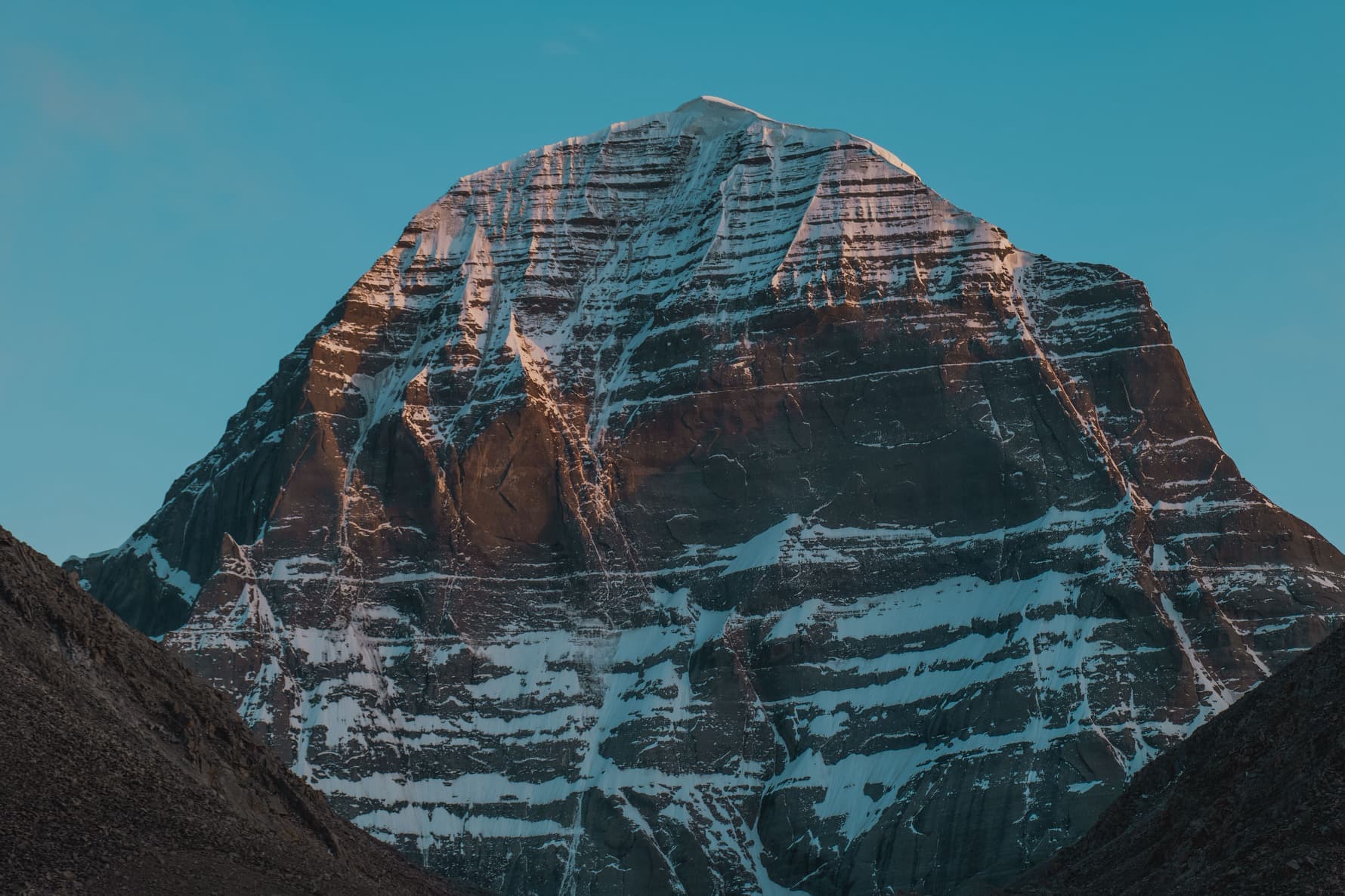
Kora Around Kailash:
With a Guide or Independently

Introduction to the Sacred Journey

Kailash is a sacred mountain revered in Buddhism, Hinduism, Bon, and Jainism. For Hindus, it is the abode of Shiva; for Buddhists, it is the center of the Demchok mandala, a place of power and awakening. Pilgrims from around the world come here to perform kora—a ritual circumambulation of the mountain that purifies karma, brings merit, and can change your life.
The Significance of Kailash in Buddhism and Hinduism
In Tibetan Buddhism, it is believed that one kora around Kailash cleanses the sins of one lifetime, while 108 circumambulations open the path to liberation. Hindus believe that each circle washes away the consequences of unwholesome deeds and brings one closer to fulfilling their deepest intentions. Honestly, for many, this is not just a belief—pilgrims recount how after completing kora, new cycles began in their lives, solutions emerged, and clarity was born.
A Brief Overview of the Kora Route and
Its Spiritual Value
The classic route is about 52 kilometers through the highlands of Tibet. You will pass over the Dolma La Pass (5,630 m), the highest and most symbolic point of the journey, encounter the sacred lakes of Manasarovar and Rakshas Tal, and stand before monasteries and stupas where generations of yogis have prayed.
Physically, this is not easy: altitude, rocks, and weather. Psychologically, it is even more challenging: fatigue exposes habitual reactions and forces you to see yourself without embellishments. But that is precisely the point. Kora is not a tourist hike. It is inner work that requires preparation—both of the body and the mind. Before hitting the trail, clarify your intention—why you are going. And respect the local culture: people live here for whom these stones, lakes, and passes are sacred every day.
Independent Travel or With a Guide
Kora is accessible for both independent travelers and groups with guides. If you are going alone, study maps in advance, stock up on food, check your first aid kit, and be prepared for changing weather—it can be capricious at altitude. Experience in high-altitude trekking and navigation skills are not just useful here; they are critically important.
With an experienced guide, the journey becomes safer and, I must say, deeper. The guide knows the trail, recognizes the signs of altitude sickness before you do, will tell you about power spots, and share stories that are not found in guidebooks. A group creates a support network—when it gets tough, you are not alone, and that can be decisive.
If this format appeals to you, check out the program Kailash: Sacred Kora from Lhasa or Kailash via Nepal: Kora with Gosainkunda. We have been conducting groups since 2015, and for us, kora is not a service but a service to this place.
Pros and Cons of Traveling with a Guide

The choice between an independent path and being accompanied by a guide affects everything: safety, depth of experience, and inner state. Let's consider the advantages and possible limitations of a group trip.
Professional Support and Safety
At altitudes above 4,500 meters, the body operates in stress mode. An experienced guide sees the first signs of altitude sickness—headache, nausea, disorientation—and can timely adjust the pace, suggest a stop, provide necessary medications, or make the decision to descend. We have had cases in our groups where the guide noticed a participant's deteriorating condition before they themselves realized it—and that saved the situation.
Moreover, the guide knows the trail, the weather patterns of the season, safe places to sleep, and contacts for local doctors and rescuers. This is not paranoia—it is the reality of high-altitude trekking.
The Guide's Knowledge of Local Culture and History
Kailash is surrounded by layers of myths, practices, and traditions. Without a guide, you see stones and lakes. With a guide, you learn that here Milarepa meditated in a cave, that this stream is considered the tears of a goddess, and that offerings are traditionally left at this stupa. This knowledge does not entertain—it deepens your presence and helps you "read" the space you are in.
I had a moment during kora when the guide shared the story of the Dolma La Pass—and suddenly I felt that I was walking not just on a trail, but on the path of thousands of people before me. It changed everything.
Support in Difficult Situations
High-altitude trekking exposes weaknesses—both physical and emotional. Fatigue, cold, fear, doubts: "Why did I come here? Will I be able to make it?" In a group, you are not alone. The guide maintains a space of calm, participants support each other, and this helps you get through the crisis. In practice, the most challenging moments often become the most valuable—if there are people around who hold you up.
If the idea of traveling with support resonates with you, take a look at Kailash: Sacred Kora from Lhasa—this is a program with acclimatization, experienced Tibetan guides, and attention to each participant.
Possible Limitations
The group format implies a shared pace and schedule. If complete autonomy is important to you—stopping wherever you want, going at your own rhythm, changing plans spontaneously—a guide may seem like a limitation. This is an honest point, and it is worth considering.
But experience shows that at Kailash, what matters more is not speed and freedom of maneuver, but the readiness to trust the process. And here, the support of a guide often outweighs the loss of flexibility.
Independent Kora: Is It Worth It?

Going around Kailash independently is a serious choice. It requires experience, preparation, and the willingness to take on all risks. Let's consider what it offers and what challenges you may face.
Advantages of Autonomy and Flexibility of the Route
You choose the pace, departure time, and stopping places. Want to meditate by a lake? You stop. Feeling tired? You take an unscheduled rest day. There is no need to adjust to a group, explain your decisions, or wait for others. For experienced travelers who practice solitude or have a clear personal intention, this can be important.
Financially, an independent kora is cheaper: you do not pay for a guide, can choose simple accommodation, and cook for yourself. But the savings are relative—more on that below.
Risks: Health, Route Difficulties, Language Barrier
-
Altitude Sickness. This is the main risk. At Dolma La Pass, you will be at an altitude of 5,630 m, and symptoms can develop quickly: headache, nausea, dizziness, pulmonary or cerebral edema. Without experience, recognizing the signs in time is difficult. It is dangerous without help nearby.
-
Navigation and Weather. The trail is not always obvious, especially in fog or after snowfall. GPS helps, but batteries die, and signals can be lost. Weather can change in an hour: sunny in the morning, blizzard in the afternoon. If you are not prepared for this, it is easy to get lost or find yourself in a dangerous situation.
-
Language Barrier. Few people in villages and guesthouses speak English. If a problem arises—injury, illness, loss of belongings—it will be difficult to communicate.
-
Loneliness. Physical and psychological. When it gets tough, there is no one to share it with. For some, this toughens them up; for others, it breaks them.
Useful Tips for Independent Travelers
If you decide to go alone, here is a checklist to help reduce risks:
-
Physical Preparation. Start cardio training 3–4 months in advance: running, cycling, hiking with a backpack. If possible, train at altitudes of 3,000–4,000 m.
-
Route Study. Download offline maps (maps.me, Gaia GPS), study trail descriptions, and mark key points: guesthouses, water sources, medical posts.
-
Acclimatization. Don't rush. Spend 2–3 days in Lhasa or Kathmandu at an altitude of 3,500–4,000 m, then gradually ascend. Gain no more than 300–500 m in altitude per day after 3,000 m.
-
First Aid Kit. Diamox (acetazolamide) for altitude sickness prevention, pain relievers, anti-inflammatories, stomach upset remedies, band-aids, antiseptics.
-
Communication and Plan B. Bring a satellite phone or tracker (Garmin inReach). Leave a copy of your route with loved ones. If you feel worse—descend, don’t be a hero.
-
Respect for Culture. Circumambulate stupas and mani stones clockwise, do not photograph those praying without permission, and do not make noise near sacred sites. This is not a tourist attraction—it is a living tradition.
If you are unsure of your experience or want to combine independence with safety, consider Kailash via Nepal: Kora with Gosainkunda—a program with a flexible schedule and guide support, but without rigid group dynamics.
Budget and Financial Aspects

The financial aspect often determines the choice between an independent kora and a trip with a guide. Let's break down the real numbers and hidden costs.
Cost Comparison of Traveling with a Guide vs. Independently
-
With a Guide. A comprehensive tour (Lhasa—Kailash—Lhasa, 10–14 days) costs between $800 and $1,800 per person. The price usually includes: transportation, accommodation, meals, guide services, and permits. The level of comfort, group size, and season affect the price.
-
Independently. The budget ranges from $400 to $1,000, depending on accommodation, transportation, and meal choices. But there are nuances: permits for entering Tibet for foreigners can only be obtained through agencies, and it is nearly impossible to legally enter the Kailash region independently. If you go through Nepal—it is easier, but permits are still required.
In practice, "independent" kora often means a minimal group without a full package of services, but with basic logistics provided by an agency.
Expenses for Food, Accommodation, Transportation, and Additional ServicesFood.
— Self-catering (cooking): $10–15 per day.
— Cafes, guesthouses: $20–40 per day.
— Tours usually include full board (breakfast, lunch, dinner).
Accommodation.
— Simple guesthouses: $10–25 per night.
— Mid-range (Lhasa, Kathmandu): $30–80.
— In organized tours, accommodation is included, often at verified places with hot water and relative comfort.
Transport.
— Local buses, shuttles: $5–20 per trip.
— Jeep rental with driver (Lhasa — Kailash): $300–600 per vehicle (shared among the group).
— Transport is included in tours.
Additional Services.
— Equipment rental (sleeping bag, trekking poles): $30–100.
— Porters, yaks for carrying items: $50–150 for the entire route.
— Emergency evacuation (if needed): from $500.
Budget Saving Tips
-
Travel in the off-season. May and September are optimal times: fewer tourists, lower accommodation prices, comfortable weather.
-
Form mini-groups. If you are traveling with friends or find travel companions, you can share costs for transport and guides.
-
Book in advance. Prices are usually lower 2–3 months before the trip, especially for tours and flights.
-
Choose package tours. Often cheaper than arranging everything separately, plus logistics and safety issues are resolved.
If you value reasonable prices without sacrificing quality, check out Kailash: Sacred Kora from Lhasa — we strive to maintain a balance between accessibility and depth of experience.
Logistics: How to Prepare for the Kora

Preparing for the kora around Kailash involves not only equipment but also documents, acclimatization, and understanding the seasons. Let's break it down.
Optimal Time for Hiking
-
April — June. Spring and early summer. Stable weather, little snow, trails are open. May is the ideal month: warm during the day, cool at night, minimal precipitation. However, there are many tourists.
-
July — August. Rainy season (monsoon in Nepal). Less precipitation in Tibet, but thunderstorms, fog, and wet trails are possible. If you don't mind the dampness, you can go; there are fewer people.
-
September — October. Autumn. Clear weather, excellent visibility, comfortable temperatures. September is the second most popular month after May. By the end of October, it gets cold, and snow is possible.
-
November — March. Winter. Passes are covered in snow, temperatures at night drop to -20–30 °C, many guesthouses are closed. Only for extreme adventurers with experience in winter high-altitude trekking.
We usually guide groups in May and September — this is the golden time.
Necessary Documents and Permits
For Tibet (via China):
— Visa for China.
— Tibet Travel Permit (entry permit for Tibet) — issued only through accredited agencies.
— Alien's Travel Permit (for visiting closed areas, including Kailash).
— Military Permit (for certain regions).
Processing takes 2–4 weeks, and it cannot be done independently.
For Nepal:
— Visa for Nepal (issued upon arrival).
— If you are going through the Nepalese side (a rare route) — permits for trekking in the Kailash area.
In our programs (Kailash: Sacred Kora from Lhasa, Kailash via Nepal), we handle the permit arrangements — you only need a passport and a completed application form.
List of Necessary Equipment and Clothing
Clothing (in layers):
— Thermal underwear (top + bottom).
— Fleece jacket or down vest.
— Membrane jacket and pants (wind and water protection).
— Warm hat, gloves, buff.
— Trekking boots with ankle support (broken in!).
— Spare socks (3–4 pairs).
Backpack and Gear:
— Backpack 40–60 liters.
— Sleeping bag (comfort down to -10 °C if staying in guesthouses; down to -20 °C if camping).
— Tourist mat (foam pad or inflatable).
— Trekking poles.
— Headlamp, spare batteries.
— Thermos, water bottle.
First Aid Kit:
— Diamox (for altitude sickness prevention).
— Pain relievers (ibuprofen, paracetamol).
— Stomach upset remedies (loperamide, smecta).
— Band-aids, antiseptic, bandage.
— Personal medications (if you have chronic illnesses).
Documents and Money:
— Copies of passport, visas, insurance (in a waterproof bag).
— Cash in yuan or dollars (there are almost no ATMs).
Important Aspects of Acclimatization
Acclimatization is key to a safe kora. Ignoring this stage leads to altitude sickness, evacuation, and a spoiled experience.
- Principles: —
- Ascend slowly. After 3,000 m, gain no more than 300–500 m in altitude per day. —
- Sleep lower. If you ascend to 4,500 m during the day, sleep at 4,200 m. —
- Drink plenty of water. 3–4 liters per day. Dehydration worsens altitude sickness symptoms. —
- Listen to your body. Headache, nausea, weakness — these are signals. Do not ignore them. If symptoms worsen — descend.
Acclimatization Schedule (example):
— Day 1–2: Lhasa (3,650 m) — rest, walks.
— Day 3: transfer to Shigatse (3,800 m).
— Day 4–5: transfer to Lake Manasarovar (4,500 m), overnight, short walks.
— Day 6: start of kora (starting point — 4,600 m).
In our programs, acclimatization is built into the itinerary, so you won't rush and won't take risks.
Medications:
— Diamox (acetazolamide) — take one day before ascent and during, 125–250 mg twice a day. Consult a doctor.
— Dexamethasone — only for emergencies of severe altitude sickness.
Preparing for the kora requires attention, but if you do everything right, the journey will become not a survival test, but a profound spiritual experience.
FAQ

What is the optimal route for the kora around Kailash?
The classic route is 52 km over 3 days (sometimes extended to 4 for acclimatization). Start from Darchen (4,600 m), then the Lha Chu valley, Dirapuk Monastery (first overnight, 5,000 m), ascent to Dolma La Pass (5,630 m), descent to Dzuthulpuk (second overnight, 4,900 m), return to Darchen.
Key points: sacred lake at the pass, Stone of Salvation, valley of the 84 Mahasiddhas. If you have time, add a day to circle Lake Manasarovar — it enhances the experience.
Our programs (Kailash: Sacred Kora from Lhasa) include this route with guide support and acclimatization.
What risks exist when hiking independently?
-
Altitude sickness. The main danger. Symptoms can develop quickly, and without experience, you may not recognize them in time.
-
Weather. Blizzards, fog, sharp temperature changes. Without knowledge of the area, it's easy to stray from the trail.
-
Lack of medical assistance. The nearest hospital is several hours away, and mobile reception is not available everywhere.
-
Loneliness. Psychologically challenging, especially if problems arise.
With a guide, these risks are minimized.
What level of physical fitness is needed for the kora?
Medium to high. You should be able to walk 15–20 km a day with a backpack weighing 7–10 kg at altitude. The Dolma La Pass involves an ascent to 5,630 m, and if you lack high-altitude experience, it will be difficult.
Preparation:
— Start cardio training 3 months in advance: running, cycling, stair climbing with a backpack.
— If possible, go on a hike at altitudes of 3,000–4,000 m.
— Focus on building endurance rather than strength.
If your physical condition is not ideal, you can hire porters or yaks to carry your gear — this will reduce the load.
How to choose between traveling with a guide and an independent route?
Go with a guide if:
— You have no experience in high-altitude trekking.
— You want to understand the culture and spiritual significance of the places more deeply.
— Safety and support are important to you.
Go independently if:
— You have experience trekking at altitudes above 4,000 m.
— You are confident in your navigation skills and are prepared for risks.
— Complete autonomy is critically important to you (though permits still need to be arranged through agencies).
Honestly, for your first kora, we recommend a guide. It's not about distrust in your abilities — it's about respecting the mountain and yourself.
What safety recommendations are there for the Kailash region?
— Acclimatize.