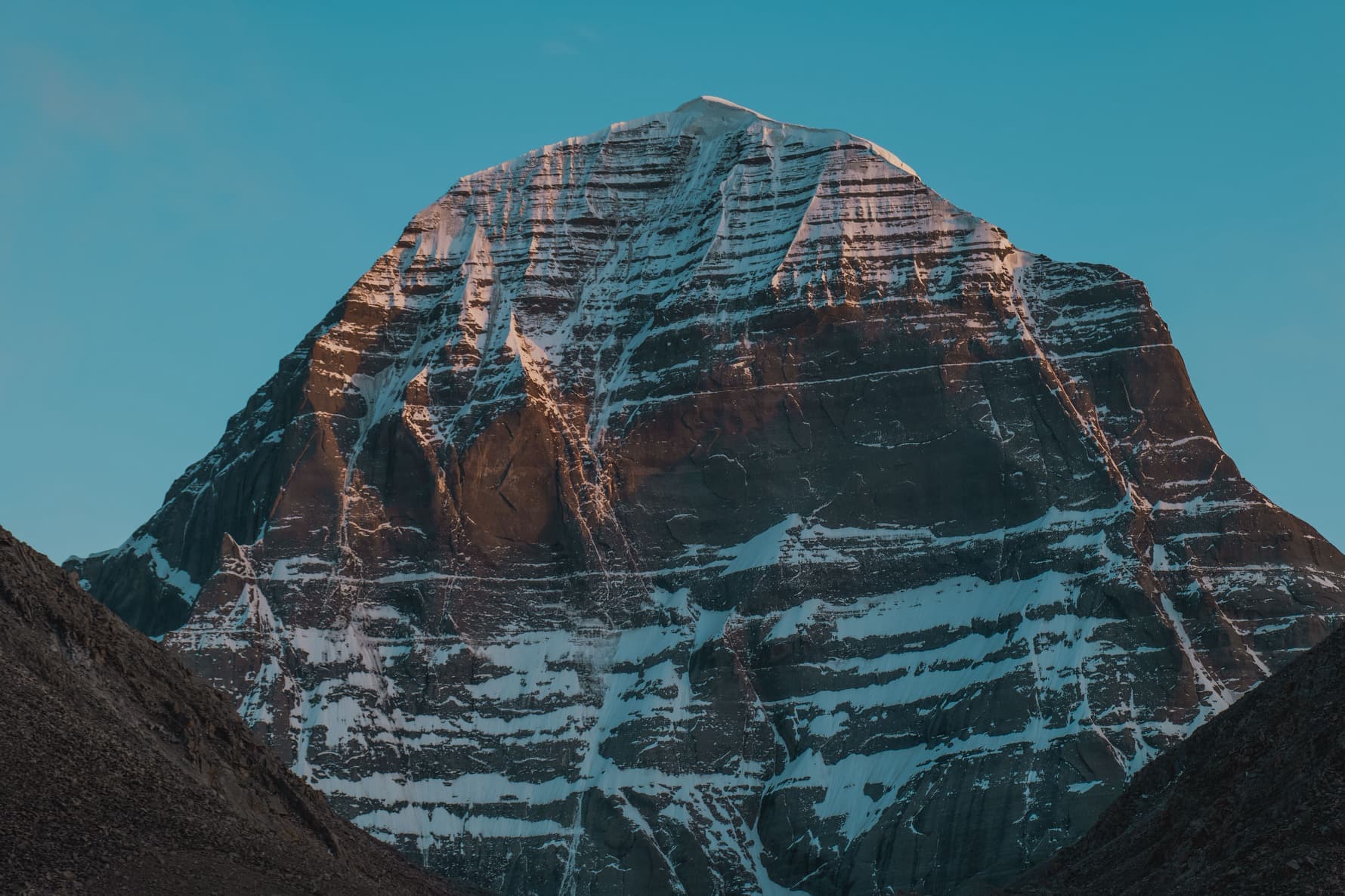
Kora Around Kailash Dolma La:
Your Guide to the Sacred Pilgrimage 2026

Introduction to the Kora Around Kailash

The kora around the sacred mountain Kailash is a transformative pilgrimage. Not only does the body traverse these 52 kilometers, but something within also shifts. The Dolma La Pass becomes the point where physical effort transitions into awareness: you are capable of more than you thought.
Typically, the kora takes three to five days, depending on your group's preparation and pace. I've seen people walking slowly, stopping at every turn to feel the place. And those who hurried to "finish the route." Honestly, the former took away more.
Kailash is revered by several traditions. In Buddhism, the mountain is considered the abode of Avalokiteshvara—the bodhisattva of compassion. Hindus see it as the home of Shiva. Jains call it the place of liberation for Mahavira. Each faith brings its rituals: some chant mantras, some walk silently, some prostrate. All of this exists side by side, without conflict.
What to Consider Before Setting Out on the Route
-
Physical Condition. The kora is not technical mountaineering, but the load is serious. Regular cardio training two to three months before the trip, hiking with a backpack weighing 8–12 kg, and stair climbing will help your body not protest at high altitudes.
-
Acclimatization. Spending a few days in Lhasa or another high-altitude location is not a formality. The body needs to get used to the thin air. We allocate time for this in our groups specifically: it's better to spend a day resting than to turn back halfway.
-
Equipment. Quality trekking boots with a stiff sole, a waterproof jacket, thermal underwear, a head covering, and sunscreen with SPF 50+ are the minimum. The sun at high altitudes burns even through clouds. Your first aid kit should definitely include altitude sickness medication, pain relievers, and blister plasters.
-
Route. If you are going for the first time, it makes sense to choose a proven program with an experienced guide. For example, Kailash: Sacred Kora from Lhasa includes acclimatization, transfers, and support at all stages. There is also an alternative route through Nepal—Kailash via Nepal: Kora with Gosainkunda, where you will see the mountain from another side and additionally visit sacred lakes.
-
Mindset. Prepare not only physically. The kora is an inner journey. Some come with questions, some with gratitude, some simply open up. Give yourself time for this.
The pilgrimage around Kailash is not a tourist route in the usual sense. It is an opportunity to meet yourself in a place where thousands of people before you have done the same. Approach it with respect and care for yourself—and it will respond.
Route and Details of the Kora

The classic kora route is about 52 kilometers, usually completed in 3–4 days. The path begins in Darchen, a small village at the southern slope of Kailash, and goes clockwise—this is customary in Buddhist tradition (Bon followers go counterclockwise).
How the Route is Structured: Key Points and Distances
Day 1: Darchen — Dirapuk (20 km).
The first section is a gentle ascent along the valley. You pass prayer flag poles, stupas, and meet Tibetan pilgrims, many of whom are walking with prostrations. The altitude gradually increases—from 4600 to 5000 meters. By evening, there is a guesthouse or tent camp in Dirapuk, with a view of the northern wall of Kailash.
Day 2: Dirapuk — Dolma La Pass — Zutulpuk (18–22 km).
The most challenging day. The ascent to Dolma La (5630 m) begins early in the morning. The path is steep, the air is thin, and every step requires effort. At the pass, there is a scattering of prayer flags and stones that pilgrims walk around while chanting mantras. It is customary to leave something symbolic here—a strand of hair, a piece of cloth—as a sign of letting go of the old.
After the pass, there is a long descent to Zutulpuk. The legs get tired, but the landscape compensates: the emerald Gaurikund Lake (at an altitude of about 5600 m), red rocks, silence.
Day 3: Zutulpuk — Darchen (14 km).
The final section. A calm descent through a wide valley. The body relaxes, and the mind does too. Many say that it is on the last day that some inner resolution or clarity comes.
Significant Places Along the Way
Gaurikund — a sacred lake just below the Dolma La Pass. According to legend, Parvati, the wife of Shiva, bathed here. The water is icy, but some pilgrims dip in or at least wash their faces—as a ritual of purification. I saw people doing this in complete silence, not for photos, but for themselves.
Dolma Stone. A large boulder at the pass, around which pilgrims walk three times. It is believed that this helps to relieve karmic debts. There is always someone praying nearby, while others simply stand and gaze at the mountain.
How the Kora Through Tibet Differs from the Route Through Nepal
The classic route from Lhasa is an immersion in Tibetan culture: monasteries, villages, encounters with locals. You see Kailash from a distance, then gradually approach it. The program Kailash: Sacred Kora from Lhasa provides exactly this experience—a slow, mindful one.
The route through Nepal (Kailash via Nepal: Kora with Gosainkunda) includes an additional pilgrimage to the Gosainkunda lakes, with more trekking sections in the foothills of the Himalayas. The mountain reveals itself from another side—both literally and symbolically. It takes a bit longer, but it is more diverse in landscape and cultural layers.
Every step on the kora is not just a kilometer. It is a dialogue with the place, with yourself, with the reason you came here. Prepare in advance: study the map, clarify the altitudes, allocate time for acclimatization. And remember: the main thing is not speed, but presence here and now.
Dolma La Pass: Height, Features, and Preparation

Dolma La is a pass at an altitude of 5630 meters, the highest and most demanding point of the kora. Physically, it is a test. Spiritually, it is a threshold after which many feel that something within has shifted.
Conditions at the Pass and What You May Encounter
The weather here is unpredictable. It may be clear in the morning, and within an hour, there could be snow or piercing wind. Daytime temperatures range from -5 to +10 °C, while at night they drop to -15 °C or lower. The wind can knock you down if it is present. If not, the silence is such that you can hear the breath of the person ahead.
Main challenges:
-
Altitude Sickness. Headache, nausea, weakness, insomnia—classic symptoms. If they intensify, you need to stop, rest, and if necessary, descend to a lower altitude. I've seen people ignore their body's signals and then lose consciousness. There’s no need to be a hero.
-
Physical Load. The ascent to the pass begins at 4–5 AM to reach it by noon (the weather often deteriorates in the afternoon). The path is steep, rocky, snowy, and the air is thin. Even prepared individuals move slowly and take frequent breaks.
-
Psychological Pressure. At high altitudes, everything is heightened: fatigue, fear, doubts. Some begin to question why they even came here. This is normal. The main thing is not to run away from these thoughts but to keep moving step by step.
How to Prepare Physically and Mentally
Training 2–3 Months Before the Trip.
Running, hiking with a backpack, stair climbing, cycling—anything that strengthens the heart and legs. Ideally, get out to the mountains at an altitude of 2500–3000 meters so your body begins to acclimatize to the thin air.
Acclimatization on Site.
You cannot fly to Lhasa and set out on the kora the next day. You need at least 3–4 days for adaptation: leisurely walks, light activity, plenty of water, and no alcohol. The program Kailash: Sacred Kora from Lhasa includes this by default—you gradually gain altitude, visit monasteries, and get used to the rhythm.
Gradual Progression.
Don’t rush ahead. The first day of the kora is at a calm pace. The second is the hardest, but if you haven’t exhausted yourself the day before, your chances of crossing Dolma La are higher.
Equipment.
Warm layered clothing (thermal underwear, fleece, waterproof jacket), windproof pants, quality trekking boots with a stiff sole, gloves, a hat, and a buff. Trekking poles are essential, especially on the descent.
Medical Preparation.
Consult a doctor before the trip. Bring Diamox (acetazolamide) with you—it helps with acclimatization. Pain relievers, anti-nausea medication, and blister plasters. All of this will come in handy.
What Participants in Our Groups Say
One of the pilgrims who completed the kora last year wrote: “At the pass, I realized that I could do more than I thought. Not in terms of physical strength. I mean—I can let go of what I’ve been carrying for years. The Dolma Stone, the flags, the wind… I just stood there and cried. And it became easier.”
Another participant shared: “I was the last in the group, thinking I wouldn’t make it. The guide stayed with me, not rushing. We took two hours instead of one to ascend. But when we reached the pass—it was mine. Not someone else's achievement, but mine.”
Dolma La Pass is not just a high point on the route. It is a place where what is inside manifests. Prepare for it with respect, and it will become one of the most powerful memories of your life.
Safety and Health During the Kora
 The circumambulation around Kailash is a serious physical challenge at high altitude, where the body operates under stress. Safety here is not a formality; it determines whether you will reach the end or turn back halfway.
Risks You May Encounter
Acute Mountain Sickness (AMS).
Headache, nausea, weakness, dizziness, insomnia. It appears at altitudes above 3500 meters and worsens above 5000. At the Dolma La Pass (5630 m), symptoms can become critical. Ignoring them can lead to pulmonary or cerebral edema, which is life-threatening.
Hypothermia and Dehydration.
Cold, wind, dry air. The body loses moisture faster than you notice. You need to drink not when you feel thirsty, but regularly — at least 3–4 liters a day.
Injuries.
Sprained ankles, strains, blisters that turn into wounds. It's easy to slip on rocks, especially when descending from a pass.
Medical Preparation: What to Bring
Before the trip — definitely see a doctor. If you have chronic conditions (heart, lungs, blood pressure) — get permission for high-altitude activities.
First Aid Kit (minimum set):
-
Diamox (Acetazolamide) — helps the body acclimatize to altitude. Take it one or two days before the ascent and during.
-
Ibuprofen or Paracetamol — for headaches, inflammation.
-
Cerucal or Ondansetron — for nausea.
-
Band-aids, bandages, antiseptic — for treating blisters and abrasions.
-
Personal medications — if you take something regularly, bring extra.
-
Oximeter (if possible) — measures blood oxygen saturation. If it drops below 80% and does not rise — you need to descend.
How to Avoid Mountain Sickness: Practical Rules
Acclimatization is key.
Don’t fly straight from the plains to Kailash. Spend 3–4 days in Lhasa (3650 m), then a day or two in Darchen (4600 m). Ascend gradually.
Drink plenty of water.
Even if you don’t feel like it. This reduces the risk of AMS.
Don’t rush.
“Pole pole” (Swahili: “slowly-slowly”) is the golden rule of high-altitude trekking. The slower you go, the easier it is for your body.
Listen to yourself.
If you have a splitting headache, feel nauseous, or dizzy — stop. Rest. If it doesn’t get better in an hour — descend. No pass is worth your life.
Don’t drink alcohol or smoke.
This exacerbates oxygen deprivation.
Eat light food.
Soups, cereals, nuts, dried fruits. The stomach has a hard time digesting fatty and heavy foods at altitude.
How to Choose a Guide and Group
A good guide is not just someone who knows the route (that’s a given), but someone who can assess the condition of the people. I’ve seen guides who forced people to go against their will. And those who calmly said: “We’ll stay here today, we’ll continue tomorrow.”
What to pay attention to:
-
Experience working at altitude. Mountains up to 3000 meters and Kailash are different worlds.
-
Group size. Ideally 8–12 people. More than that, the guide physically cannot pay attention to everyone.
-
Medical training of the guide or accompanying person. Oxygen, medications, communication — all of this should be available.
-
Reviews from real participants. Not general enthusiasm, but specifics: how problems were solved, whether there were difficulties, how the guide reacted.
In our programs — Kailash: Sacred Circumambulation from Lhasa or Kailash via Nepal: Circumambulation with Gosainkunda — we allocate time for acclimatization, go at a comfortable pace, and always have an extra day in case of bad weather or poor health. This is not a luxury, but a necessity.
Your health is a priority. Prepare seriously, don’t be a hero on the route, and the circumambulation will become an experience of strength rather than a survival test.
Budget and Logistics

A pilgrimage to Kailash requires not only internal preparation but also smart budget planning. Honestly: it’s not cheap. But if you understand in advance what the costs consist of, you can avoid surprises and focus on the journey itself.
What Costs Are Involved: Real Figures
Transport.
Flight Moscow — Kathmandu / Delhi — from $400–600 round trip (depends on the season and point of purchase). Then — a domestic flight or ground transfer to Lhasa / the Tibet border. Transfer from Lhasa to Kailash by bus or jeep — another $200–400. Private transfer is more comfortable but can cost $600–800.
Accommodation.
In Lhasa — from $15–30 per night in a guesthouse, $50–100 in a mid-range hotel. On the way to Kailash and in Darchen, conditions are simpler: $10–25 per night. On the circumambulation itself — basic guesthouses without amenities, sometimes just tents. Hot water is often unavailable.
Food.
$10–20 per day. On the circumambulation, food is simple: rice, noodles, soup, tea. In cities, the selection is wider. Bring snacks: nuts, dried fruits, energy bars — you can’t buy them in the mountains.
Permits and Visas.
Visa to China (if going through Tibet) — from $100. The Tibetan permit (Tibet Travel Permit) is obtained through a travel agency; you cannot get it on your own. The cost is about $50–100, but it is usually included in the tour price. Nepalese visa (if going through Nepal) — $50 upon arrival.
Additional Expenses.
Insurance covering altitude up to 6000 m — mandatory, from $50–100. Rental of equipment (if you don’t have your own): sleeping bag, poles — $20–50 for the entire period.
How to Plan
Your Budget: A Simple Scheme
-
Determine the total amount.
Minimum — $1500–2000 per person (if traveling independently, staying in guesthouses, saving). A comfortable option with an organized tour — $3000–5000. -
Divide by categories:
-
Flights: 30–40% of the budget.
-
Accommodation: 20–25%.
-
Food: 10–15%.
-
Transfers, permits, guide: 25–30%.
-
Reserve for unforeseen expenses: 10%.
- Set aside a reserve.
Weather may force you to stay an extra day. Or you may need additional medical assistance. 10–15% extra is not excessive.
Important Information About Booking and Documents
Air Tickets.
Buy them 2–3 months in advance. Flexible dates offer discounts. Keep an eye on sales.
Permits.
The Tibet Travel Permit cannot be obtained by yourself — only through an accredited agency. Processing takes 2–4 weeks, so start early.
Group Tours.
If you go through an organizer, most permits, transfers, and accommodations are already included. This is easier and often cheaper than gathering everything separately.
What Is Included in Jay Shambo Programs
When you choose Kailash: Sacred Circumambulation from Lhasa or Kailash via Nepal: Circumambulation with Gosainkunda, you receive not just a route, but complete logistical support:
-
All transfers — from airport pickup to return. Comfortable jeeps, experienced drivers, no unexpected additional charges.
-
Accommodation — vetted guesthouses and hotels. We know where it’s clean, where you can charge your phone, where the owners treat pilgrims with respect.
-
Food — adapted to altitude and exertion. No heavy meals before ascending the pass.
-
Guide with high-altitude trekking experience — a person who not only knows the trail but feels the group's condition.
-
Processing of all permits — you don’t waste time on bureaucracy.
-
Acclimatization days, backup time — if the weather doesn’t allow you to go on the route, we have a plan B.
We do not skimp on your safety and comfort. But we also don’t inflate the price for the sake of the fancy term “premium.” Everything included in the cost is designed to allow you to focus on what matters most — the pilgrimage itself.
Prepare for the trip in advance, plan your budget realistically — and the journey to Kailash will become not a stress but what it should be: a sacred journey.
Frequently Asked Questions About the Circumambulation Around Kailash

What is the height of the Dolma La Pass?
The Dolma La Pass is at an altitude of 5630 meters above sea level. This is the highest point of the circumambulation around Kailash and one of the most demanding places on the route. At this altitude, the air is about half as dense as at sea level, so preparation and acclimatization are critically important.
How many days does it take to circumambulate Kailash?
Typically 3–4 days,