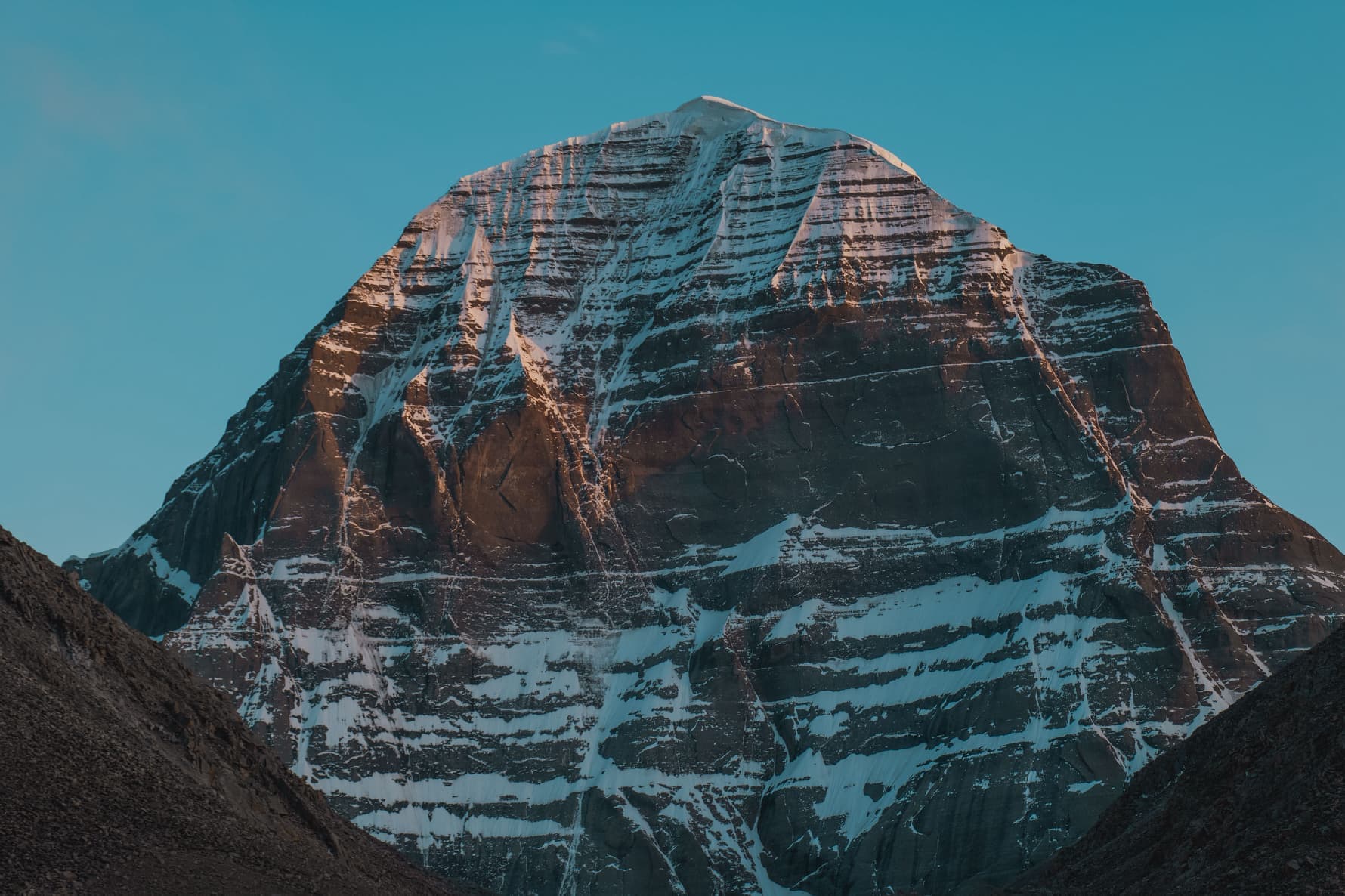
Kora Around Mount Kailash: How to Trek the 52-Kilometer Route

What is the Kora Around Kailash and Why is it Important

The kora around Kailash is a 52-kilometer circumambulation of the sacred peak, one of the most significant pilgrimage routes in the world. For Buddhists, Hindus, Jains, and adherents of the Bon religion, this path is not just a physical journey. Pilgrims believe that completing the full circuit purifies karma, brings one closer to enlightenment, and can erase the sins of many lifetimes.
I have led groups on the kora more than twenty times and have witnessed how people change over these three days. Some arrive with a clear spiritual intention, while others seek to challenge themselves at high altitude. Yet everyone leaves with an experience that cannot be gained on any other trek.
Historical and Cultural Context
Mount Kailash has been revered for thousands of years. Hindus consider it the home of Shiva, Buddhists associate it with Buddha Chakrasamvara, Jains connect it with the first Tirthankara Rishabha, and Bon followers link it to the founder of their tradition, Tonpa Shenrab. Each sees something personal in this peak, yet all follow the same path.
The route has been shaped over centuries. Here you will encounter simple monasteries, prayer flags, mani stones with mantras, and the footprints of thousands of pilgrims. At the highest point—the Dolma La Pass (5,630 m)—it is customary to leave something personal behind: a lock of hair, a piece of clothing, a photograph. This symbolizes letting go of the past.
Nearby Kailash are two sacred lakes—Manasarovar (pure, ritual) and Rakshas Tal (dark, considered a dwelling of demons). Many programs include a ritual bathing in Manasarovar before the kora as part of traditional preparation.
Why People Choose This Trail
Everyone has different goals. Some come for spiritual cleansing, others to test themselves in extreme conditions, and some to see one of the most beautiful landscapes in Tibet. In practice, all these motives intertwine.
What Awaits You on the Route
-
Altitude: The highest point is 5,630 m (Dolma La Pass). Even well-prepared individuals may experience shortness of breath, headaches, and weakness. Acclimatization is a must.
-
Weather: Snow can fall even in July, the wind at the pass can knock you down, and nighttime temperatures drop to –10…–15 °C. Your gear must be reliable.
-
Accommodation: Overnight stays in simple guesthouses or tents. There is no electricity, water is heated with wood or gas, and toilets are outdoors. Comfort, in the usual sense, is absent here.
To be honest, the kora is not a walk in the park. Yet it is this difficulty that makes the journey valuable. When you stand at Dolma La Pass and see how far you have come, you realize you are capable of more than you thought.
If you are interested in a program with full logistics, acclimatization, and guide support, take a look at our route Kailash: Sacred Kora from Lhasa. For those wanting to combine the kora with a trek in Nepal, we offer Kailash through Nepal: Kora with Gosainkunda.
Route Details: How the 52-Kilometer Kora is Organized

The kora around Kailash is not a circular route of a single level of difficulty. There are gentle sections where you can walk at a relaxed pace, and steep climbs where each step is a challenge. Let me describe what the path looks like in practice.
Route Description: Key Points, Ascents, and Descents
Starting point—Darche (4,560 m), finishing point—the same. The route goes clockwise (as practiced by Buddhists and Hindus; Bon followers circumambulate counterclockwise). Most pilgrims complete the kora in three days, but it is possible to do it in two if you are physically fit.
Day 1: Darche — Dirapuk (20 km, elevation gain ~500 m)
The first day is the longest in terms of distance but relatively easy. The trail follows the valley, gaining elevation gradually. You will pass the Chuku Monastery, prayer flags, and carved stones. The landscape is meditative: gray rocks, sparse bushes, yaks grazing.
By evening, you will reach Dirapuk—a small guesthouse at the northern wall of Kailash. From here, you get one of the best views of the northern face of the peak. Many wake up before dawn to catch the sunrise on Kailash—it’s worth it.
Day 2: Dirapuk — Dolma La Pass — Zutulpuk (18 km, elevation gain 630 m, descent 700 m)
The toughest day. The ascent to Dolma La starts early—usually around 5–6 AM—to cross the pass before noon (after lunch, snow or fog often sets in).
The trail is rocky and steep, and the air thins. Every 50 meters, you may feel the need to stop. But at the pass, you are greeted by a field of prayer flags, the Gauri Kund Lake (frozen most of the year), and a view of the valley you will descend into.
The descent is steep and long. Your knees tire, and the stones are slippery. By evening, you will reach Zutulpuk—another modest guesthouse. Here, everyone collapses to sleep, exhausted but fulfilled.
Day 3: Zutulpuk — Darche (14 km, descent ~400 m)
The final section is a gentle descent through a wide valley. Your body is tired, but your mind is clear. You have completed the full circuit.
Distance and Load Distribution
The classic scheme is three days
- Day 1: 20 km, 6–8 hours of walking. Acclimatization, getting used to the backpack and altitude.
- Day 2: 18 km, 8–10 hours. The main load—the Dolma La Pass. A critical day for those who have not acclimatized well.
- Day 3: 14 km, 4–6 hours. Easy finish, recovery.
Some strong groups complete the kora in two days (the first day to Dirapuk, the second day for the rest). However, I do not recommend rushing: the kora is not a race. Three days allow you to experience the journey rather than just rush through it.
Important Landmarks on the Route
- Chuku Gompa Monastery (Day 1)
- Northern Wall of Kailash (view from Dirapuk)
- Gauri Kund Lake (at Dolma La Pass)
- Milarepa’s Cave (near Zutulpuk)
We send participants a detailed map and GPS track before the trip. It’s hard to get lost—the trail is singular, but landmarks help plan your day and make stops in the right places.
If you value a well-structured itinerary, acclimatization in Lhasa, and support from an experienced guide, check out the program Kailash: Sacred Kora from Lhasa.
How to Prepare for the Trek: Tips from an Experienced Guide

The kora around Kailash is accessible to people without mountaineering experience but requires serious preparation. Altitude, long transitions, cold, and wind—all of these are stressors on the body. Here’s how to prepare to enjoy the route rather than endure it.
Physical Preparation: Which Exercises Really Help
Start training 2–3 months before the trip. The goal is endurance, strong legs, and familiarity with long walks while carrying a backpack.
What Works in Practice:
-
Walking with a Backpack: 2–3 times a week for 1.5–2 hours. Gradually increase the weight to 8–10 kg. Ideally, walk on uneven terrain, hills, and stairs.
-
Cardio: Running, cycling, swimming—3–4 times a week for 40–60 minutes. This develops your heart and lungs, which is crucial at altitude.
-
Strength Exercises for the Legs: Squats, lunges, step-ups. These strengthen your quadriceps and knees, which bear the main load on descents.
-
Breathing Practices: Pranayama, breath-holding. These help you cope better with the thin air.
You don’t need to be a marathon runner. But if you can comfortably walk 15 km with a backpack on hilly terrain—you are ready.
Gear: What to Bring with You
Proper equipment is half the success. There are no stores on Kailash, and the nearest town is hundreds of kilometers away. Everything you need must be with you.
Clothing:
- Membrane jacket (wind and waterproof)
- Down jacket or warm synthetic jacket
- Fleece jacket (mid-layer)
- Thermal underwear (top and bottom)
- Trekking pants (quick-drying)
- Warm socks—3–4 pairs, including thermal socks
- Gloves, hat, buff
Footwear:
- Trekking boots with a stiff sole and good ankle support. Be sure to break them in beforehand—blisters on the kora will turn the path into torture.
- Camp shoes or sandals for the evening
Equipment:
- Backpack 40–50 liters (if you go with porters, you can go smaller—25–30 liters for the day)
- Trekking poles (reduce knee load by 20–30%)
- Sleeping bag (comfortable to –10 °C; if staying in guesthouses, a lighter one can suffice)
- Water bottle or hydration system 2–3 liters
- Sunglasses (UV 400), SPF 50+ cream, lip balm
- Headlamp with spare batteries
- First aid kit (more details below)
What NOT to Bring:
- Heavy equipment (drones are prohibited in Tibet)
- Extra clothing (there’s no place to wash; you carry everything)
- Valuables
Acclimatization and How to Avoid Altitude Sickness
Altitude sickness is the main risk on the kora. Symptoms include headaches, nausea, weakness, and insomnia. In severe cases, it can lead to pulmonary or cerebral edema. This is no joke.
How to Properly Acclimatize:
-
Ascend Slowly. The classic rule: do not gain more than 300–500 m in elevation per day after reaching 3,000 m.
-
Sleep Lower than You Climb. If you ascend to 4,500 m during the day, it’s better to sleep at 4,200 m.
-
Drink 3–4 liters of water a day. Dehydration exacerbates symptoms. Urine should be light.
-
Don’t Rush Your Pace. Walk at a pace where you can comfortably hold a conversation. Shortness of breath is a signal to slow down.
-
Listen to Your Body. If you have a pounding headache, feel nauseous, or dizzy—stop. It’s better to lose a day than to ruin your entire trip.In our programs (Kailash: Sacred Kora from Lhasa), we allocate 4–5 days for acclimatization in Lhasa and on the way to Darchen. This is not an over-cautious measure — it is a necessity.
Altitude First Aid Kit:
- Diamox (acetazolamide) — prevention of altitude sickness (by doctor's prescription)
- Ibuprofen or paracetamol — for headaches
- Activated charcoal, Smecta — for stomach issues
- Plasters, bandages, antiseptic
- Personal medications
Be sure to consult with a doctor before the trip. The Kora is contraindicated for serious heart, lung diseases, or hypertension.
Preparation is not a formality. It is a respect for the mountain and for yourself. When you are physically and mentally ready, the Kora becomes a profound experience rather than a torment.
Risks and Challenges: What You Need to Know Before the Trek

The Kora around Kailash is neither extreme mountaineering nor a casual hike. There are real risks, and it’s better to be aware of them in advance to prepare properly. I have seen people who dropped out on the second day and those who completed the Kora at the age of 65. The difference lies in preparation and honesty with oneself.
Altitude Problems: Symptoms and What to Do
Altitude sickness is the most common reason people do not finish the Kora. At the Dolma La Pass (5,630 m), the oxygen in the air is about half of that at sea level. The body does not have time to adapt — symptoms start to appear.
Mild form (in 60–70% of participants):
- Headache
- Mild nausea
- Weakness, fatigue
- Insomnia
This is normal and usually passes within a day or two with proper acclimatization.
Moderate form (in 10–15%):
- Severe headache, unrelieved by medication
- Vomiting
- Dizziness
- Shortness of breath at rest
You need to stop, rest, and drink more water. If it doesn’t help — descend to a lower altitude.
Severe form (rare, but dangerous):
- Pulmonary or cerebral edema
- Confusion
- Coughing up foam or blood
- Loss of coordination
This is life-threatening. The only solution is immediate descent and evacuation.
What to Do if You Feel Unwell:
- Stop. Don’t try to be a hero.
- Inform your guide or group.
- Drink water, take ibuprofen.
- If you don’t feel better after 30–60 minutes — descend.
- In case of severe symptoms — evacuation (there is a clinic in Darchen, but facilities are limited).
I always tell groups: the Kora is not a competition. If you feel you can't go on — stop. The mountain will still be there.
Challenging Sections of the Route and Terrain Features
The Kora is not a flat trail. There are sections that require concentration and caution.
Ascent to Dolma La (second day):
Steep rocky slope. The rocks can be slippery (especially if it has snowed). The trail is narrow, and at times you have to step over boulders. The pace is slow — 1–2 km/hour. There is not enough air, and you stop every 50 meters.
Descent from the Pass:
Steep, long (about 700 m in height over 6–7 km). The knees take a heavy load. If you have joint problems — bring elastic bandages or knee pads. Trekking poles are essential.
River Crossings:
In some places, the trail crosses streams. Usually, there are stones or rudimentary bridges, but in spring (May–June) the water can be high. Your shoes should be waterproof or bring spare socks.
Rockfalls and Landslides:
Rare but possible, especially in rain or after snowfall. Don’t linger under steep slopes, walk quickly and quietly (loud noises can trigger rockfalls).
Weather Conditions: What to Prepare For
The weather on Kailash is unpredictable even in summer. It can be sunny in the morning, snowing at noon, and windy with frost in the evening.
Seasonal Breakdown:
-
May–June: warm during the day (+10…+15 °C), around 0 °C at night. Rain and wet snow are possible. Rivers are full.
-
July–August: the warmest period, but rainy season. The trail can be muddy, visibility poor. Many pilgrims.
-
September–October: the best time. Clear weather, little precipitation, comfortable temperatures (+5…+10 °C during the day, –5…–10 °C at night). High season.
-
November–April: cold (down to –20…–30 °C), snow, the pass may be closed. Only well-prepared groups tackle the Kora.
What to Consider:
-
At Dolma La Pass, temperatures are always 10–15 degrees lower than in the valley. Even in summer, it can be –5 °C with strong winds.
-
UV rays at high altitudes are 2–3 times stronger. You can get sunburned in a couple of hours. Sunscreen SPF 50+ and sunglasses are a necessity, not an option.
-
The weather changes quickly. You might start the morning in a T-shirt, and an hour later be putting on a down jacket. Dress in layers.
Safety Checklist:
- Check the forecast before heading to the pass
- Start early in the morning (before 6:00) to cross Dolma La before noon
- Bring extra warm clothing and a raincoat
- Do not stray from the group in poor visibility
- Carry a whistle and flashlight
Honestly: the Kora involves risk. But it is manageable. If you acclimatize, take the right gear, and listen to your body — your chances of completing the route are high.
In our programs, we lead groups with extra time, a medical first aid kit, and constant communication with the base. This does not absolve your responsibility but provides support in critical situations.
You can learn more about how we ensure safety on the route on the page Kailash via Nepal: Kora with Gosainkunda.
Logistics and Budget: Everything About the Trip to Kailash

The Kora around Kailash is not just a trek; it is also a serious logistical challenge. Tibet is a closed region, and you can only get there through an organized tour, with permits and a guide. I will explain how the trip is organized and how much it costs in practice.
How to Get to the Starting Point of the Kora
The start of the Kora is the village of Darchen (4,560 m) in western Tibet. There are two main ways to get there: through Lhasa (Tibet) or through Kathmandu (Nepal).
Route via Lhasa (classic):
- Fly to Lhasa (from Beijing, Chengdu, Kathmandu, or by train from mainland China).
- Spend 3–4 days acclimatizing: visit Potala, Jokhang, Sera and Drepung monasteries.
- Drive by off-road vehicle or bus to Darchen (about 1,200 km, 3–4 days on the road with stops).
On the way, there are acclimatization overnight stays in the towns of Shigatse, Saga, and Paryang. You will pass by Lake Manasarovar, perform a ritual washing (optional), and arrive in Darchen the day before the Kora.
Route via Nepal (alternative):
- Fly to Kathmandu.
- Drive by jeep through the border crossing of Ghyirong (Nepal) / Kyirong (Tibet).
- Then continue through Saga and Paryang to Darchen (2–3 days).
This route is shorter, but the acclimatization is worse — going straight from Kathmandu (1,400 m) to over 4,000 m. You need to allow extra days for adaptation.
You cannot arrive in Darchen independently. Foreigners need the following permits to enter Tibet:
- Tibet Travel Permit (main permit)
- Alien's Travel Permit (for the Ngari region where Kailash is located)
- Military Permit (for certain areas)
The tour operator handles the paperwork. Without these permits, you will be turned back at the border or in Lhasa airport.
How Much Does the Kora Cost: Budget Breakdown
The total cost of the trip to Kailash depends on the route, comfort level, and group size. Here are approximate figures for 2026 (in US dollars).
Permits and Visas:
- Chinese visa: $140–200 (depends on the country)
- Tibet Travel Permit: included in the tour price (processed by the operator)
- Alien's and Military Permits: also included in the package
Flights:
- Moscow — Beijing / Chengdu — Lhasa: from $600 (round trip, depending on the season)
- Moscow — Kathmandu (if via Nepal): from $500
Ground Transportation:
- Lhasa — Darchen — Lhasa (off-road vehicle, 7–8 days): $300–500 per person (in a group of 4–6 people)
- Kathmandu — Darchen — Kathmandu