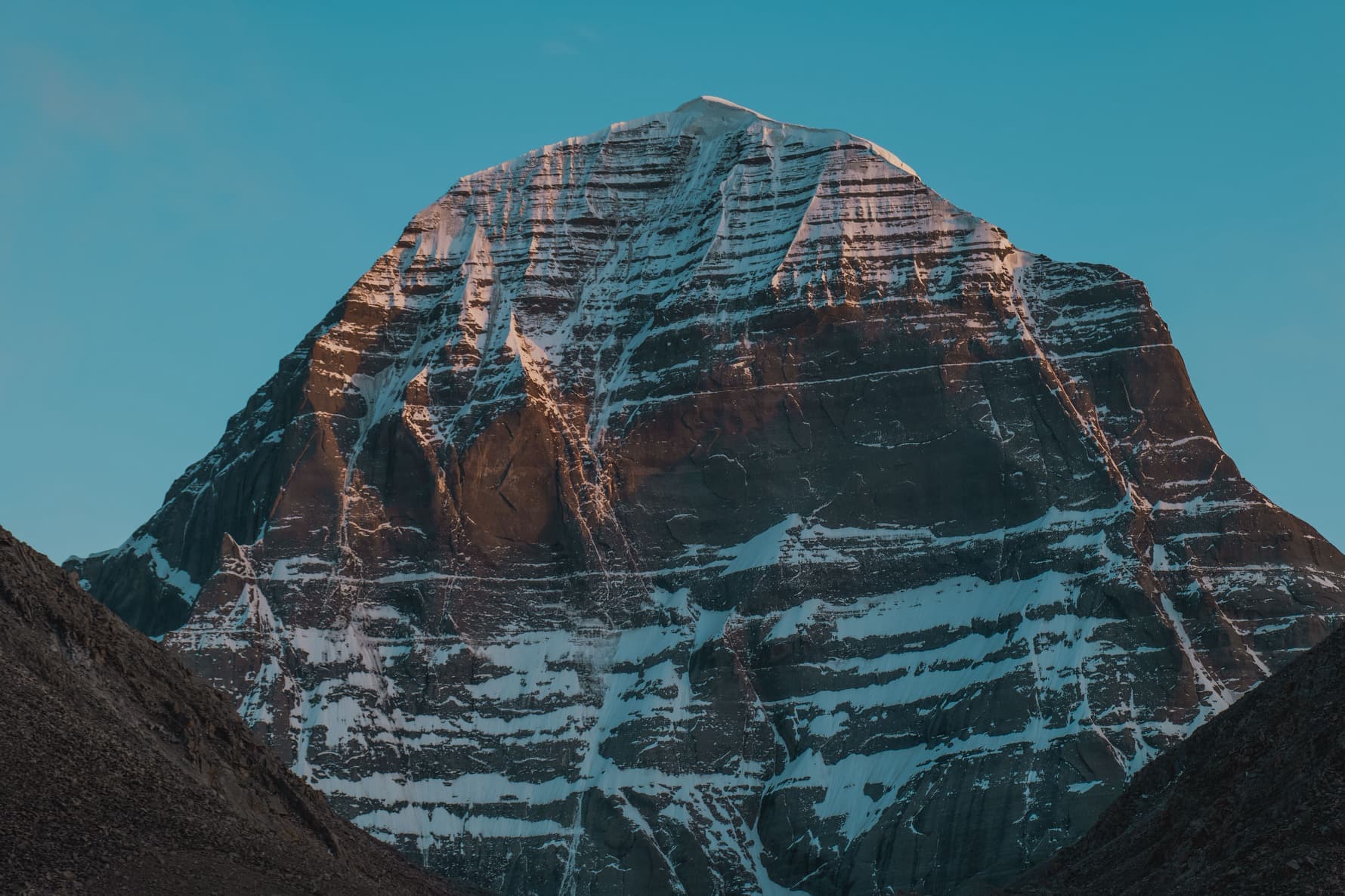
Kailash Kora: 52-Kilometer Route Around Mount Kailash

The Kora around Kailash is not a trek in the usual sense. It is a ritual circumambulation of the holy mountain undertaken by pilgrims from four traditions: Hindus, Buddhists, Jains, and Bonpo. The route spans altitudes of 4600 to 5630 meters, taking from one to three days and requiring preparation that is more about inner readiness than physical fitness.
I have led groups to Kailash for several years. I have seen people walk in silence, cry at the Drolma La Pass, and return with the feeling that something inside has shifted. The Kora is not about kilometers. It is about meeting yourself at a height where the air is halved, but the space for thoughts is doubled.
In this material, I provide a practical breakdown of the route: what to expect at each segment, how to prepare, where to stop, and what to bring. No romanticization, but also no simplifications. Honestly.
What is Kora and Why is it Undertaken
Kora (Tibetan: སྐོར་བ, khorwa) is a ritual circumambulation of a sacred site in a clockwise direction. Buddhists walk from left to right, while Bon followers go in the opposite direction. It is believed that each circuit around Kailash cleanses the karma accumulated in one life; 108 Koras liberate one from the wheel of rebirth.
In practice, most pilgrims complete one Kora. Tibetans sometimes do it in 18-20 hours of continuous movement. Western travelers typically stretch the route over two to three days, staying in guesthouses.
I do not urge you to believe in karma cleansing. However, physically, the Kora serves as a powerful practice of presence: monotonous movement, thin air, and minimal distractions. The mind clears itself.
Route Length and Altitude Profile
The classic Kora is 52 kilometers. This is an average figure; GPS tracks show between 51 and 56 km depending on whether you visit monasteries and chortens along the trail.
Altitude Profile: Start in Darchen at 4600 m, Lha-Chu Valley (western part) 4700–4900 m, Drolma La Pass 5630 m (highest point)
Lham-Chu-Khir Valley (eastern part) 5000–4700 m, Return to Darchen 4600 m
The elevation gain is over 1000 meters. This is not a technical difficulty (the trail is well-trodden, without rocks or glaciers), but an oxygen one. At 5600 meters, the air is about half as dense as at sea level. The heart races, breathing becomes labored, and each step requires concentration.
A physically healthy person with two to three days of acclimatization in Darchen will be able to complete the Kora without drama. But it will not be easy.
Day-by-Day Route: Classic Option (2-3 Days)
Day 1: Darchen to Dira-Puk (20 km, 6-8 hours)
You set out from Darchen early in the morning around seven or eight, when the sun just starts to touch the southern face of Kailash. The first five kilometers involve a gentle ascent along the Lha-Chu Valley. To the left is the western face of the mountain, and to the right are low hills and lung-ta flags at every turn.
After an hour of walking, the first key point: Tarbuche Flagpole. Here, in May (on the lunar calendar on the day of Vesak), Tibetans erect a 30-meter pole with new prayer flags. The ceremony gathers thousands of pilgrims. If you are walking at another time, the flagpole still stands tall, wrapped in colorful ribbons, serving as the center of a mandala.
The trail continues alongside the river. The elevation gain is smooth but noticeable: from 4600 to 4900 meters. The air thins, and the pace slows. Here, you can already see how Tibetan pilgrims perform prostrations, lying flat on the ground, standing up, taking a step, and lying down again. A full Kora in prostrations takes two to three weeks.
Approximately at the 12-kilometer mark is Chuku Monastery (4820 m). It is small, active, with an altar inside and a view of the northern wall. You can enter, leave an offering, and sit in silence. The monks are friendly but speak very little English.
The last eight kilometers to Dira-Puk are the most beautiful. The valley narrows, and Kailash reveals its full power. You walk directly toward the northern wall, a 2000-meter vertical face of black rock, covered with snow and ice. The air is cold, even in July. The wind calms only in the evening.
Dira-Puk (5080 m) is a guesthouse and monastery at the foot of the northern wall. Almost everyone who does the Kora in two days spends the night here. Conditions are spartan: wooden bunks, sleeping bags (bring your own), an outdoor shared toilet, and dinner of rice, noodles, and tea. Electricity is from solar panels, and candles are used in the evening.
Falling asleep is difficult. Not only because of the altitude but also because tomorrow you face the pass.
Day 2: Dira-Puk to Zuthul-Puk (18 km, 8-10 hours)
Wake-up call is at four in the morning. Tea, a bit of food (you can't eat much with a compressed stomach), headlamp, warm jacket. You leave at five while it is still dark.
The first four kilometers involve a steep ascent to Drolma La Pass. The elevation gain is 550 meters, with an angle of 20-25 degrees. The trail is rocky, with patches of snow. You move slowly, breathing through your mouth, counting steps. Every 50 meters, you stop for a breath, then continue.
Dawn catches you halfway. The sky transitions from black to blue, then to pink. Kailash glows behind you, and ahead are the silhouettes of pilgrims, a chain of lights from headlamps.
Drolma La Pass (5630 m) is the highest point of the Kora. Here is a pile of stones, thousands of flags, and the frozen Gauri-Kund Lake (Lake of Compassion). Traditionally, you need to walk around the lake three times, leave something personal (a strand of hair, a piece of clothing, a photo of a loved one), and make an intention.
I have seen people cry here. Not from the altitude, not from exhaustion. From something else. One participant in our group said, “I realized that everything I was carrying inside could be let go.” Perhaps it is hypoxia. Perhaps not.
The descent from the pass is steep and sharp, dropping 600 meters in two hours. The knees ache, and poles are a lifesaver. The trail winds between stones and then opens into the wide Lham-Chu-Khir valley.
Then comes a gentle descent along the river. Another 12 kilometers to Zuthul-Puk (4790 m), the second guesthouse on the route. Conditions are slightly better here: there is a shower (cold) and a café with a menu. It’s easier to sleep, and your head no longer pounds.
Day 3: Zuthul-Puk to Darchen (14 km, 4-5 hours)
The final section is easy. The valley is wide, sloping down, and there is more air. You pass by Zuthul-Puk Monastery (you can enter; inside is the cave where Milarepa meditated), then follow the river to the confluence with the main valley.
The last five kilometers are on a dirt road, almost flat. Kailash is visible behind you, already far away. Darchen greets you with dust, the noise of trucks, and the smell of roasted meat from roadside cafés.
The Kora is complete.
One-Day Option (for Experienced Pilgrims)
Tibetan pilgrims complete the Kora in 12-18 hours. They leave at midnight from Darchen, reach the pass at dawn, and return by evening. No overnight stays, with the minimum of gear.
For a Western person, this is possible, but it requires:
- Excellent acclimatization (at least 4-5 days in Darchen or Lhasa)
- Experience in high-altitude trekking (Everest Base Camp, Annapurna, or similar)
- A light backpack (up to 5 kg)
- Psychological readiness for 16+ hours of continuous movement
I led one group where two participants completed it in a day. Both were marathon runners and had trained for three months. They succeeded but said, “Never again.”
If you are unsure, don’t rush. The Kora does not tolerate haste.
Difficulty Level and Physical Preparation Requirements
Technically, the Kora is simple. The trail is wide, marked, without rocks, safety measures, or crossings. In terms of difficulty, it is like a long hike in the mid-mountains.
Physiologically, it is a different matter. The altitude weighs down. At 5000+ meters, the resting pulse is 90-100 beats; while moving, it is 130-140. Headaches, nausea, dizziness may occur. Sleep is shallow. Appetite disappears.
What you need:
- Regular cardio workouts for 2-3 months before the trip (running, cycling, swimming, 3-4 times a week for 40-60 minutes)
- Experience in multi-day hikes (at least 2-3 outings of 15-20 km with a backpack)
- Healthy knees (the descent from Drolma La is a serious load)
- Absence of chronic diseases of the heart, lungs, or vessels
What is not necessary:
- Climbing training
- Youth (I have led people over 60; they walked slower but completed the trek)
- Perfect shape (stability is key, not peak power)
If you can walk 20 km with a 7-8 kg backpack in one day and not perish, you will manage.
Acclimatization: Why It Is Critical
The main mistake is arriving in Darchen and going directly on the Kora. The probability of reaching the pass is about 30%. The rest will turn back with headaches, nausea, and edema.
Minimum acclimatization scheme:
- 2 days in Lhasa (3650 m)
- Transfer to Darchen with an overnight stay in Saga or Pariyang (4500-4700 m)
- 2 days of rest in Darchen (day hikes in the valley, short walks)
- Departure on the Kora
In total, at least 5 days from arrival in Lhasa to the start.
Best scheme (as we do in the Kailash Pilgrimage):
- 3 days in Lhasa with excursions (Potala Palace, Jokhang, monasteries)
- Transfer to Darchen via Shigatse and Saga (2 days of travel with overnight stays)
- 3 days in Darchen: one day hike to Lake Mansarovar, one to the start of the Kora and back, one rest day
- Departure on the Kora
In total, 8-9 days. It sounds long, but it is a guarantee that you will make it.
We had one participant who flew to Lhasa, after two days took a jeep, and the next day went on the Kora. At the pass, he had to be taken away on a horse due to pulmonary edema. He was saved, but he did not complete the Kora.
Do not skimp on acclimatization time. Seriously.
Weather and Seasonality: When to Go on Kora
May to September is the main season. The pass is open, snow is minimal, and temperatures are bearable.
June to August is the peak. Many pilgrims, guesthouses are full, and there may be queues at the pass. But the weather is stable: during the day +10…+15 °C in the valley, at night 0…+5 °C, at the pass -5…0 °C.
May and September are quieter and cooler. Nights at Dira-Puk can drop to -5…-10 °C, and at the pass -10…-15 °C. There is more snow, but the trail is passable. Fewer people mean more silence.
October to April is winter. Snowfalls, frosts down to -30 °C, and the pass is often closed. The Kora is only done by prepared groups with guides and full winter gear. We do not conduct such tours.
The best month, in my opinion, is early September. The main crowd has left, the weather is still good, and the air is clear. It is cold at night, but a -10 °C sleeping bag helps.
Accommodation and Meals on the Route
Guesthouses
Dira-Puk and Zuthul-Puk are the two main overnight spots. The conditions are similar:
- Shared rooms for 6-12 people, bunks with mattresses
- Bring your own sleeping bag (or rent one on-site, but it's better not to risk it)Street toilet, hole in the ground
Electricity in the evening, from solar panels (you can charge your phone, but there are few sockets)
Shower only at Zutul-Puk, cold, for an extra fee (30–50 yuan)
You can't book in advance. Just come, and you will be accommodated. In peak season, it might be crowded, but there will be a place.
The cost of accommodation is 100–150 yuan per person (≈ 1200–1800 rubles). Dinner and breakfast are usually included.
Food
Both guesthouses have cafes. The menu is simple:
Noodles (momo, thukpa)
Rice with vegetables or egg
Tea (sweet Tibetan with milk and salt, black, herbal)
Cookies, chocolate (bring your own, it's expensive there)
Portions are small, but at higher altitudes, you won't eat much anyway. The main thing is hot drinks. Drink tea constantly, about three to four liters a day.
Do not drink water from rivers (yaks graze, sewage from guesthouses). Either boil it or buy bottled water in Darche (stock up on 4–5 liters for two days).
Can you carry a tent and cook for yourself?
Yes, you can. Tibetans set up tents along the route and cook on stoves. But:
Tent + sleeping bag + stove + food = extra 5–6 kg in your backpack
At altitude, every extra kilogram feels twice as heavy
Firewood doesn't grow above 4500 m, only stoves (and lots of gas)
It's cold and windy at night; a tent without a vestibule is a challenge.
We recommend guesthouses. Yes, they are spartan, but having a roof over your head and a hot dinner is a lot.
What to bring: gear checklist
Clothing (layers)
- Base layer: thermal underwear (top + bottom, synthetic or wool)
- Middle layer: fleece or thin down jacket
- Outer layer: wind and waterproof jacket and pants (Gore-Tex or similar)
- Additional: down vest or jacket for the evening and pass
- Pants: trekking, quick-drying (don't bring jeans!)
- Headwear: buff, fleece hat, sun cap
- Gloves: thin fleece + warm windproof
- Socks: 3–4 pairs of trekking socks (wool + synthetic)
Footwear
Trekking boots with a stiff sole, ankle support, and membrane. Broken in! (Not new.)
Spare shoes for the guesthouse (light sneakers or sandals)
Backpack and accessories
40–50 liter backpack with a hip belt and sternum strap
Trekking poles (two, telescopic) will save your knees on the descent
Sleeping bag comfortable to -10 °C (or rent on-site, but your own is more reliable)
Sleeping mat or inflatable mattress (if you’re camping; guesthouses have mattresses)
Headlamp with spare batteries
Sunglasses category 3–4 (the sun is harsh at altitude)
Sunscreen SPF 50+, lip balm
Thermos 0.5–1 l for hot tea on the route
Personal first aid kit
- For altitude: Diamox (by doctor’s prescription), Ibuprofen
- For pain: Nurofen, No-spa
- For stomach: Smecta, Loperamide
- Plasters: regular and blister plasters (Compeed)
- Elastic bandage (in case of sprains)
- Antiseptic, wet wipes
Documents and money
Passport (original)
Chinese visa and Tibet permit (arranged by the tour operator)
Cash in yuan (cards don’t work on the route; ATMs only in Lhasa and Shigatse)
Electronics
Phone (no signal on the route, but for photos)
Power bank 10,000–20,000 mAh
Charging at guesthouses is difficult
Camera (if you bring one; cold drains the battery, keep spares warm)
Food (additional)
Bars (muesli, protein) 6–8 pcs
Nuts, dried fruits 300–500 g
Dark chocolate (carbohydrates + mood)
Lozenges (for dryness in the throat)
Electrolytes in powder (rehydration salts, isotonic)
Total backpack weight 7–10 kg. If it's more, reconsider your list.
Permits and organizational matters
You cannot enter Tibet independently. An organized tour with an accredited Chinese agency is required, which arranges:
Tibet Travel Permit (TTP) the main permit for entry into Tibet
Alien's Travel Permit (ATP) for travel to Ngari (Kailash region)
Military Permit for restricted areas (arranged by the guide on-site)
Documents must be submitted 15–20 days before the trip, requiring a passport scan and Chinese visa.
The visa for China is a separate story. From 2027, Russians do not need a visa for trips up to 15 days, but a visa is always required for Tibet (regardless of the visa-free regime). It can be arranged at the consulate or visa center, taking 4–5 days, costing around 5000 rubles.
We collect the entire document package as part of the Kailash pilgrimage; you just send the scans, and the team takes care of the rest.
Safety and medical risks
Main risks
Altitude sickness (AMS Acute Mountain Sickness): Symptoms: headache, nausea, dizziness, weakness, insomnia
Occurs at heights of 2500+ m, peaks at 4500–5500 m
Prevention: slow ascent, plenty of fluids, Diamox (by doctor’s prescription)
Treatment: descent, oxygen, rest
- Pulmonary (HAPE) and cerebral edema (HACE): Rare but dangerous. Symptoms: cough with foam, confusion, coordination issues
Immediate descent and evacuation are required
We always go with a guide who has communication and can call for help - Hypothermia: At night at Dirapuk and on the pass, temperatures can drop to -10…-15 °C (in September)
Dress in layers, keep your feet and hands dry
Dehydration: At altitude, moisture evaporates faster. Drink 3–4 liters a day, even if you don’t feel thirsty.
Medical assistance on the route
There is a clinic in Darche with oxygen bottles and basic medications. There are no medical points on the circuit. In an emergency, the guide calls for a jeep (if the road is passable) or a horse. Helicopter evacuation is not available in this area.
Insurance is mandatory. Regular policies do not cover altitude above 4500 m; get an extended one (e.g., Tripinsurance, ERV, Allianz with the "active leisure" option and coverage up to 6000 m).
Cost and budget of the trip
Estimated breakdown (for 2027)
- Organized tour (Lhasa Kailash circuit back, 12–14 days):
- Group: 150,000–200,000 ₽ per person
- Individual: 250,000–350,000 ₽ (depends on group size)
What’s included: Permits (TTP, ATP, Military)
Transport (4×4 jeep with driver, throughout the route)
Accommodation (hotels in Lhasa/Shigatse, guesthouses in Darche and on the circuit)
Food (breakfasts, road lunches, dinners on the circuit)
Guide (English or Russian speaking)
Excursions (Potala, Jokhang, monasteries)
What’s not included: Flights to Lhasa (Moscow to Lhasa from 40,000 ₽ round trip, with a layover in Beijing/Chengdu)
Chinese visa (≈ 5000 ₽)
Personal gear
Additional expenses (souvenirs, tips, extra food)
- Additional options:
- Porter on the circuit: 1500–2000 yuan (≈ 18,000–24,000 ₽) for the entire route. Carries your backpack, you go light.
- Horse: 1000–1500 yuan (≈ 12,000–18,000 ₽). You can ride the whole way or just the ascent to Drolma-La.
- Oxygen cylinder: 200–300 yuan rental (≈ 2400–3600 ₽). Rarely taken, but if you're afraid of heights, it’s a safety net.
Kailash Circuit: 52-kilometer route around Mount Kailash
What is the Kailash Circuit and its spiritual significance

The Kailash Circuit is a sacred 52-kilometer route around Mount Kailash in Tibet, considered one of the main pilgrimage paths for Buddhists, Hindus, Bon followers, and Jains. The word "kora" in Tibetan means "circumambulation," and it is indeed a spiritual practice, not just trekking. Every step around the mountain symbolizes the cleansing of karma and movement toward awakening.
For believers, one kora removes the sins of one lifetime, while 108 circumambulations free one from samsara. Honestly, even one kora changes a lot inside: the altitude, silence, effort—all of this works like a retreat in motion.
Spiritual practices associated with the kora: meditation, prayers, rituals
Pilgrimage on the Kailash Circuit combines several practices that help connect with the mountain's energy and your own nature of mind. Here’s what you will see and be able to practice yourself:
- Meditation. Pilgrims stop at certain points along the route to meditate, especially at the Drolma-La pass (5630 m). Silence, thin air, and space help to hear what is usually drowned out by noise.
- Prayers and mantras. Throughout the kora, mantras can be heard; Tibetans walk with prayer beads, repeating "Om mani padme hum," while Hindus say "Om namah Shivaya." This creates a field of concentration and reverence.
- Prostrations (kyang-chak). Some pilgrims complete the entire route while making prostrations: lying fully down, standing, taking a step, and repeating. 52 kilometers over two to three weeks. We’ve seen such individuals; it is a practice of complete devotion and letting go of the ego.
- Rituals and offerings. Pilgrims leave coins, cloth, and strands of hair at sacred stones and lakes. All this symbolizes liberation from attachments.
Practical tips for pilgrims
If you plan to complete the kora, here are some things to know in advance from the experience of our groups and personal trips:- Budget. Expect to spend $1,500–2,500 per person: this includes permits, transport within Tibet, accommodation in guesthouses, meals, and guiding services. The price varies depending on the season and group size.
- Visa and permits. A Chinese visa is required for Tibet, along with a Tibet Travel Permit and an Alien's Travel Permit. These cannot be obtained independently; they must be processed through an accredited agency. We handle everything for participants in the “Kailash: Sacred Kora from Lhasa” program.
- Hidden costs. Budget for tips for porters (if you hire help), additional meals on the way, purchasing water, souvenirs, and possible medical needs. A first-aid kit and insurance are mandatory.
- Best time. May–June and September 2027 are optimal months. The weather is stable, passes are accessible, and there is less snow. July-August brings rain, while winter has frost and closed sections.
- Physical preparation. The kora requires endurance: three days of walking at altitudes of 4,600–5,630 m, with temperature changes. Start cardio workouts like running, hiking with a backpack, and stair climbing two months before the trip. Acclimatization in Lhasa before the kora is essential.
- Guide and support. An experienced guide knows where to stop for the night, how to manage energy, and when to drink butter tea to stay warm. They will also explain the meaning of the sites and rituals, transforming the kora from a mere hike into a true pilgrimage.
If you wish to embark on this journey accompanied by people who know it intimately, take a look at our “Kailash: Sacred Kora from Lhasa” program. We lead groups with care, attention to each person's pace, and deep respect for tradition.
The kora around Kailash is a meeting with yourself at high altitudes, where the air is thin, but the space for the mind is vast. Every step here can become a step toward understanding who you are beyond your usual roles and stories.
Preparing for the trek: what you need to know

The kora around Kailash is both a physical challenge and a spiritual practice. To complete the 52 kilometers at altitudes ranging from 4,600 to 5,630 meters without setbacks, it's wise to plan your gear, clothing, and acclimatization regimen in advance. Below are the items we've tested with our own groups.
Gear selection: shoes, clothing, backpack
Shoes
Trekking boots with a rigid sole and water-resistant membrane (Gore-Tex or similar). Break them in at least a month before the trip to avoid blisters on the Dolma La pass.
Clothing (layering) thermal underwear (synthetic or merino wool) for sleeping and early starts; a fleece jacket or lightweight down jacket as temperatures at altitude can drop to -10 °C even in summer; a wind- and waterproof jacket with taped seams; trekking pants (preferably with detachable legs); hat, gloves, and buff as the wind can be strong at the pass.
Backpack
40–50 liters, with a hip belt and chest strap. Main luggage will be transported by vehicle or yak, so your backpack should only contain a day’s supplies: water, snacks, a first-aid kit, camera, and a spare fleece.
Physical preparation: how to train before the trek
Aerobic base
Running, cycling, or swimming 3–4 times a week for 40–60 minutes. In the two months before your trip, gradually increase continuous exercise to one and a half hours at a comfortable pace.
Strength training
Focus on legs and core: weighted squats, lunges, step-ups; planks, back extensions as your back will tire under the backpack just like your legs.
Hills and stairs
If there are hills nearby, train on them with a light backpack (5–7 kg). This is the closest experience to the actual kora.
Altitude acclimatization conditions and safety recommendations
Acclimatization schedule
On the Kailash: Sacred Kora from Lhasa route, three nights are planned in Lhasa (3,650 m) and a gradual ascent through Shigatse and Saga. By the time you reach the kora starting point in Darchen (4,600 m), your body will have time to adapt. If you're arriving independently, do not ascend more than 500 meters per day after reaching 3,000 m, and take a rest day for every 1,000 meters gained.
Hydration
Drink 3–4 liters of water a day, even if you don't feel thirsty. At altitude, moisture escapes through the lungs faster than at sea level.
Symptoms of altitude sickness
Headache, nausea, dizziness, shortness of breath at rest are warning signs. Inform your guide, descend to a lower altitude, and rest. Keep diacarb (as prescribed), ibuprofen, and rehydration salts in your first-aid kit.
Hidden costs meals outside the program (in guesthouses on the kora, simple dal bhat or noodles are available; if you want variety, bring packed meals); souvenirs at monasteries and from vendors on the trail; medical services if you need an oxygen mask or evacuation (insurance is mandatory).
Every step on the kora is an opportunity to see Kailash from a new perspective and to understand yourself more deeply. Prepare calmly, without haste, and the journey will be truly transformative.
Kailash Kora: 52-kilometer route around Mount Kailash
Kailash Kora route: key stages

The Kailash Kora is a 52-kilometer route around the sacred mountain of Kailash. Each stage presents both a physical challenge and an inner experience. Below are the key sections you will traverse and what to expect at each.
Description of key sections of the route and their lengths Day 1: Sutray Valley
Length: 12 km
The path begins in the majestic Sutray Valley. Here you will encounter the first sacred lakes and enjoy views of snow-capped peaks. The ascent is gentle, allowing your body to acclimate to the rhythm. Day 2: Transition to Dolma La Pass
Length: 22 km
The most challenging section: the ascent to Dolma La Pass (5,630 m). The landscape changes every hour, from sparse vegetation to bare rock and snow. Honestly: at altitude, your breath may falter, but the views make the effort worthwhile. Day 3: Descent to Lake Manasarovar
Length: 18 km
The final section is the descent to Lake Manasarovar, known for its healing properties. Here, time opens up for silence, reflection, and gratitude. Many in our groups realize the depth of their journey at this stage.
Landscape and natural features: what to expect at each stage
Each section of the Kailash Kora offers a changing environment:
- Mountain peaks and glaciers: During the ascent to the pass, you will see glaciers and towering peaks. They create a backdrop that is hard to forget.
- Green valleys and flowering fields: The early stages will delight you with green fields of flowers, a rare sight in Tibet. The ecosystem here is fragile yet alive.
- Silence and thin air: After crossing Dolma La Pass, a special silence is felt. It helps you focus on your inner experiences and let go of the hustle.
You can learn more about our route in the Kailash via Nepal: kora with Gosainkunda program.
Useful tips for travelers
- Preparation for altitude: Acclimatize well before starting the route. Set aside 1–2 days for adaptation; this is not a luxury but a necessity.
- Hydration: Drink at least 3 liters of water a day. Dehydration at altitude can mask itself as fatigue, so be attentive.
- Symptoms of altitude sickness: Headache, nausea, dizziness; inform your guide immediately. It's better to err on the side of caution than risk your health.
- Pace of movement: Walk slowly and breathe deeply. Rushing at altitude is an enemy; a calm rhythm is your ally.
Possible additional expenses Meals outside the main menu (extra snacks, tea in guesthouses). Souvenirs and offerings at monasteries. Medical services in emergency situations (insurance is mandatory but does not cover everything).
Every step on the Kailash Kora is a chance to see majestic landscapes and understand yourself more deeply. Prepare attentively, and your journey will become a transformative experience. You might also want to consider the Kailash: Sacred Kora from Lhasa program, which offers support from an experienced team and logistics tested by our groups.
Challenges and difficulties on the Kailash Kora

The Kailash Kora is not just a physical challenge, but also a profound inner journey. Along with stunning views and spiritual experiences, you will face real difficulties that are worth preparing for in advance. I will honestly share what you may encounter on this 52-kilometer route.
Altitude sickness: symptoms and precautions
As you ascend to heights where oxygen becomes sparse, many may experience symptoms of altitude sickness. Be attentive to the following signs: Headache Nausea Fatigue Shortness of breath
- Precautions:
- Acclimatization: Set aside 1–2 days for altitude adaptation before starting the route.
- Hydration: Drink at least 3 liters of water a day to avoid dehydration.
- Listen to your body: If you feel your condition worsening, inform your guide.
Difficult sections of the route: how to overcome them
The Kailash Kora includes several segments that may present challenges.
- Steep ascents: At certain stretches, you will need to climb significant heights. Use trekking poles to reduce the load on your legs.
- Slippery trails: In the rainy season, sections may become slippery. Good footwear with traction is your best friend.
- Long distances: Take your time. Make regular breaks to regain your strength.
Practical tips: Start your day early to avoid the heat and enjoy the morning freshness. Share your experiences with other group members for mutual support.
Weather conditions: how to prepare for changes in weather
The weather around Kailash can be unpredictable. Here are some recommendations for preparation:- Layered clothing: Dress in several layers to easily regulate your body temperature. Include thermal underwear, a fleece jacket, and a waterproof jacket.
- Footwear: Choose waterproof and well-insulated boots.
- Accessories: Don’t forget a hat, gloves, and sunglasses; the sun's rays at high altitudes are very intense.
Useful Tips for Travelers
Prepare a budget for: Meals off the main route. Souvenirs and gifts. Emergency medical services. Unexpected expenses related to changes in the itinerary.
Every step on the Kailash Kora is an opportunity not only to see majestic landscapes but also to understand yourself more deeply. Prepare well, and your journey will truly become transformative. You can join our program Kailash: Sacred Kora from Lhasa, where we provide support and share experiences throughout the journey.
Budget and Logistics: How to Organize Your Trip

Travel Expenses: What to Include in Your Budget
- Transport: Flights to Lhasa or Kathmandu range from $400 to $800 depending on the season and departure point. Ground transfer to the start of the kora (3-4 days of travel) costs an additional $200–$300 per person in a group. Private taxis are more expensive but allow for stops along the way for acclimatization.
- Accommodation: Guesthouses and simple hotels on the route range from $20 to $100 per night. During high season (May, September), availability may be limited, so book in advance or let the operator handle it.
- Meals: $15–$30 per day. In remote areas, options are limited, and prices are slightly higher; bring some snacks like nuts, chocolate, and dried fruits.
- Additional Expenses: Souvenirs, offerings at monasteries range from $50 to $100. Medical supplies for emergencies (doctor's consultation, evacuation) start at $100; it's better to have them and not need them.
Route Logistics: How to Get to the Start of the Kora
Through Lhasa (Tibet, China): From Kathmandu by bus (~8 hours, ~$30) or by plane. From Lhasa to Darchen (the start of the kora) involves 3-4 days of ground travel over high mountain passes. Operators often include acclimatization stops at monasteries.
- Through Nepal: The program Kailash through Nepal: Kora with Gosainkunda combines trekking in the Himalayas with a gentler kora for the body and more beautiful for the eyes.
- Visa and Permits: If traveling through Tibet, you need a Chinese visa, Tibet Travel Permit, Alien's Travel Permit, and Military Permit. These are arranged by a travel agent; tourists cannot obtain them independently. Through Nepal, logistics are simpler, with permits available at the border.
Useful Tips for Organization
- Group or solo: In a group of 4-6 people, it's cheaper to share transfers and a guide. We form intimate groups at Kailash: Sacred Kora from Lhasa, making it easier to maintain pace and adapt the program to people's conditions. An individual trip is more expensive but offers more flexibility: you can go at your own pace and stop wherever you want.
- What the operator handles: Permits, transfers, accommodation, a guide, and a porter (if needed). You are relieved from bureaucracy and receive support at altitude, which saves energy and nerves.
- Plan extra time: Weather in the mountains can change in an hour, and altitude can slow your pace. Allow for 1-2 extra days after the kora in case you want to do a second round or simply rest in Darchen.
- Keep track of expenses: Create a simple spreadsheet or note on your phone to avoid running into unexpected cash shortages in villages without ATMs.
Every step around Kailash is not only a sight but also an opportunity to see yourself more clearly. Prepare calmly, trust experienced people with logistics, and the journey will become a transformation rather than a survival quest.
FAQ

How to hike to Mount Kailash?
The classic kora route is 52 kilometers clockwise from Darchen. Most pilgrims complete it in three days, but everyone's pace is different. Before setting out, you'll need a few days at altitude in Lhasa or Saga, as going straight to 4600 meters is dangerous.
Honestly, self-guided routes rarely go smoothly: you need a permit, transport, porters or yaks, and knowledge of the trails. If you value time and peace of mind, the kora from Lhasa will answer all your questions from acclimatization to logistics.
What should you know about the Himalayan Kailash Kora?
The kora is an outer circumambulation of the mountain, which for Buddhists, Hindus, and Bonpos signifies the purification of karma from past lives. One round erases the sins of one life, according to tradition.
In practice: Along the way, you'll encounter sacred sites such as Choku Gompa, Dirapuk, and Zutulpuk. You can stop to spend the night, meditate, or light oil lamps. Pilgrims prostrate themselves along the entire route, which can take weeks. Your task is simply to walk with respect, at a leisurely pace, without littering or speaking loudly.
What dangers may arise during the kora?
Altitude, weather, and terrain are the three main risk factors.
- Altitude sickness. The Dolma La Pass lies at 5630 meters. Without acclimatization, it's easy to develop pulmonary or cerebral edema. Move slowly, drink water, and avoid alcohol and sleeping pills.
- Weather. Snow, wind, and nighttime frosts can occur even in summer. Blizzards can happen in May and September. Bring warm clothing, a rain jacket, and thermal underwear.
- Injuries. Rocks, mud, and icy sections after the pass; footwear should secure the ankle. Trekking poles are very helpful. Keep a first aid kit with bandages, adhesive tape, and pain relievers handy.
What is the total length of the route around Mount Kailash?
52 kilometers is the classic figure. In reality, from Darchen to Darchen, it is about 53-54 km, depending on where you stop for the night.
Most groups split the journey into three days: the first day 20 km to Dirapuk Gompa; the second day 18 km over Dolma La to Zutulpuk; the third day 14 km back to Darchen.
Trained hikers can do it in two days, while Tibetan yogis can complete it in one. There’s no need to rush; you didn’t come for a record.
What is the physical difficulty of the journey?
Average. Technically, the trek is simple—no climbing, ropes, or glaciers. But altitude has its effects: there's half the oxygen as at sea level, your heart beats faster, and your legs feel heavier.
What’s important:
- Endurance. You’ll be walking 6-8 hours a day with a backpack. If you struggle to walk 15 km at home, start training two months in advance.
- Altitude gain. The ascent from Darchen (4600 m) to the pass (5630 m) is nearly a kilometer. The descent also puts strain on the knees.
- Preparation. A few long hikes in the mountains, stair climbing with a backpack, and some cardio will suffice. Just avoid arriving after a year on the couch.
Every step on the kora is a dialogue with the mountain and with yourself. The body tires, the mind quiets, and something deeper than words opens up. If you want to walk the route with a reliable company, check out the program Kailash through Nepal: Kora with Gosainkunda, where acclimatization is gentler and support is available at every stage.