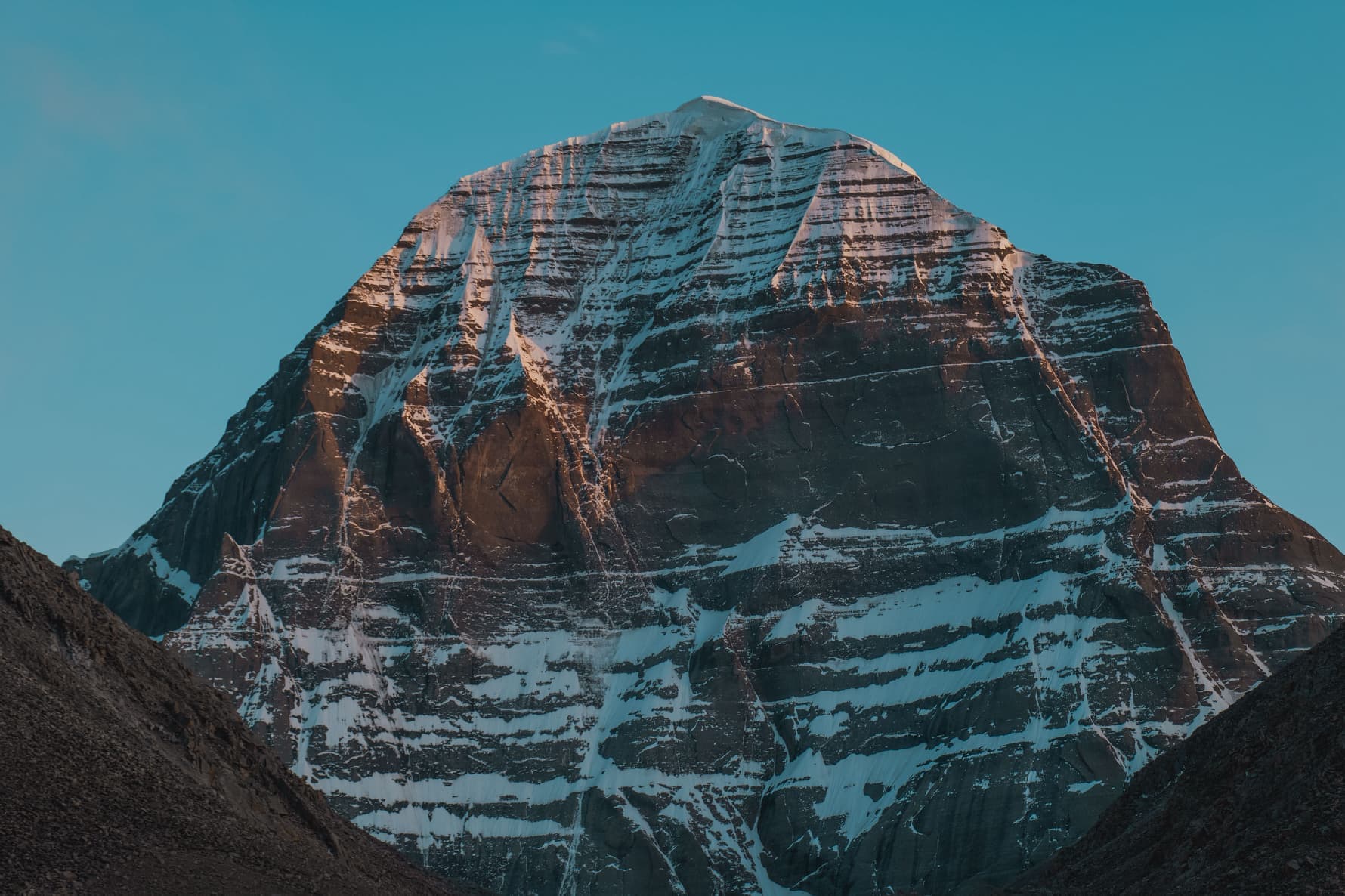
How to Trek to Mount Kailash

Introduction to the Trek to Mount Kailash

The trek around Mount Kailash is a journey that transforms people. This sacred peak is considered the center of the world for Buddhists, Hindus, Jains, and followers of Bon.
Completing the kora — the ritual circumambulation of the mountain — means connecting with an ancient tradition that spans thousands of years. You will witness pilgrims making their way, covering 52 kilometers on their knees and palms. Next to you will walk Tibetans, Indians, Nepalese — people of different faiths but with a shared purpose.
At an altitude of over 4500 meters, every step becomes mindful. The physical effort washes away the superficial, leaving only the essential — your inner dialogue with yourself and with the incredibly powerful space around you.
Brief Overview of the Route and Its Features
The classic trek around Kailash is about 52 kilometers, typically completed in three days. Some groups attempt it in two days, but we do not recommend rushing — the altitude and terrain demand respect.
Key points along the route:
- Darchen (4560 m) — the starting point, where the base camp is located.
- Dirapuk Monastery (5080 m) — the first overnight stay, offering a view of the northern face of Kailash.
- Dolma La Pass (5630 m) — the highest and most challenging point of the kora, where offerings are traditionally made.
- Zutulpuk Monastery (4790 m) — the second overnight stay in a sacred cave.
- Return to Darchen — completing the circle.
Each segment of the path holds symbolic meaning. For instance, the Dolma La Pass represents the death of the ego and rebirth. Honestly, at this section, you can physically feel your body approaching its limits — and it is at this moment that something profound happens within.
The landscapes shift from rocky plateaus to narrow gorges, from glacial rivers to colorful prayer flags. Each turn reveals a new facet of Tibet.
The Importance of Preparation and Awareness of Difficulty Levels
Altitude is the main factor of difficulty. Darchen is higher than Elbrus, and the Dolma La Pass is 500 meters higher. This should not be underestimated.
Altitude sickness can affect even well-prepared individuals. Headaches, nausea, weakness, insomnia — these are standard symptoms. We have had cases in our groups where someone had to turn back before reaching the pass. This is normal, and the key is to make timely decisions.
Preparation recommendations:
- Start regular cardio workouts 2–3 months in advance: running, cycling, long walks with a backpack.
- If possible, attempt several treks at altitudes of 3000–4000 meters.
- Be sure to undergo a medical examination. Contraindications include serious cardiovascular diseases, hypertension, and acute asthma.
Gear is a separate topic. Good trekking boots, warm layered clothing, a waterproof jacket and windbreaker, a sleeping bag rated to -10 °C, trekking poles — all of this is not a luxury, but a necessity.
The weather can change rapidly on-site. It may be sunny in the morning, snowing by noon, and piercingly windy by evening. Be prepared for anything.
The journey to Kailash requires both physical and mental preparation. But if you are ready for the challenge, this kora will become one of the most significant experiences of your life.
For more details on the program with acclimatization and support at all stages, read here: Kailash: Sacred Kora from Lhasa.
Preparing for the Trek: What You Need to Know

Good preparation is half the success. The trek to Kailash requires a serious approach, but there’s no need to be scared — with the right mindset, people of different ages and fitness levels successfully complete the kora.
Physical Preparation: Training and Exercises Suitable for the Trek
Start preparing at least two months before your trip. Ideally, three to four months in advance.
The basis is aerobic endurance. You will be walking 6–8 hours a day at altitudes where oxygen is half as abundant as at sea level.
What to include in your training:
- Running or fast walking — 3–4 times a week for 40–60 minutes. Gradually increase the time and pace.
- Long walks with a backpack — on weekends, spend 3–4 hours hiking with a load of 5–7 kg. This will help your muscles and joints adapt to the strain.
- Stair climbing or uphill walking — a great way to simulate the trek's conditions. If you live in a city, use apartment building stairs or stadiums.
- Strength exercises for legs and core — squats, lunges, planks. Strong legs and a solid back will make ascents and descents much easier.
If you have the opportunity to go to the mountains before your trip — do it. Even a short trek at 2500–3000 meters will show how your body responds to thin air.
Honestly, I’ve seen people who have run marathons struggle with altitude on Kailash, and I’ve seen those who regularly walked feeling perfectly fine. Genetics play a role, but regular training definitely helps.
Be sure to get a medical check-up. A doctor should confirm that you have no contraindications for high-altitude activities.
Psychological Preparation: Mindset and Expectations
The trek to Kailash is not a stroll. There will be moments of fatigue, discomfort, and perhaps even despair. This is normal.
How to prepare your mindset:
- Embrace uncertainty. Weather can change, your health may decline, and plans may need adjustment. Flexibility and patience are your best allies.
- Don’t chase results. The kora is not a sporting achievement. What matters is the process, your internal state, not the speed of completion.
- Practice meditation or breathing exercises. Even 10 minutes a day can help maintain inner calm during difficult moments.
In a group, there are always people who walk faster and those who go slower. Do not compare yourself to others. Your pace is your own.
Think about why you are going to Kailash. Everyone has their own answer: some seek spiritual experiences, others test themselves physically, some just want to see the sacred mountain. Clarity of purpose helps in tough moments.
Necessary Documents and Visas for Traveling to Tibet
Tibet is a closed region, and entry is only possible in organized groups with official permission.
What you will need:
- Passport — valid for at least 6 months at the time of entry into China.
- Chinese visa — obtained through a consulate or visa center. Usually, this is a tourist visa of category L.
- Tibet Travel Permit — a special permission for entering Tibet. This is arranged by the receiving party based on your passport and visa. It cannot be obtained independently.
- Additional permits — several more documents (Alien's Travel Permit, Military Permit) are required for visiting the Kailash area and border regions. All of this is handled by the tour organizer.
Important: The application process may take 3–4 weeks, so start your preparations early. We handle this bureaucracy — you just need to provide copies of your documents, and we manage the process until all permits are obtained.
Also, note that entry to Tibet is only permitted as part of a group and with a guide. Independent trekking is prohibited by law.
If you plan your route through Nepal, you can get a visa on arrival in Nepal, but you still need Chinese documents to cross the border at Kyirong.
For more information about the route through Nepal with acclimatization at Gosainkunda Lake: Kailash via Nepal: Kora with Gosainkunda.
Logistics: How to Organize Your Trip

Organizing a trip to Kailash is a multi-step process. The remoteness of the region, bureaucracy, and altitude — all of this requires attention to detail.
Flights and Transport to Start the Trek
Most routes to Kailash begin in Lhasa — the capital of Tibet.
How to get to Lhasa:
- Via China. The most convenient way is to fly through Chengdu or Xi'an — from there, there are direct flights to Lhasa. The flight takes about 2.5 hours. The round-trip ticket price from Moscow to Chengdu to Lhasa is approximately 40,000–60,000 rubles depending on the season.
- Via Kathmandu. If you choose the route through Nepal, you can reach the border by land transport from Kathmandu (about 6–7 hours), and then continue your journey to Tibet in jeeps.
For the internal flight to Lhasa, a Tibet Travel Permit is required — without it, you will not be allowed on board.
From Lhasa to Darchen (start of the kora):
The distance is about 1200 km. This is a 3–4 day journey by jeep across the Tibetan plateau. Along the way, you will see Lake Manasarovar, passes above 5000 meters, monasteries, and nomadic encampments.
The journey itself is an adventure. Asphalt alternates with dirt roads, ascents with steep descents. The landscapes are fantastic, but the bumps can be jarring. Comfortable clothing and a back cushion will be helpful.
We always plan stops for acclimatization — for example, an overnight stay in Saga (4500 m) before starting the kora.
Accommodation: Tips for Choosing Places and Booking
In Lhasa:
Here, there is a wide range of hotels — from budget guesthouses to comfortable hotels. We recommend staying in the Barkhor area (the old city) — close to Jokhang Temple and major attractions.
The average price is $30–50 per night in a good three-star hotel. Be sure to check the availability of oxygen pillows or concentrators — they can be helpful in the first days at an altitude of 3650 meters.
On the way to Kailash:
Overnight stays occur in small towns or guesthouses. Conditions are basic: clean beds, shared bathrooms, sometimes hot water (but not always). Electricity may be intermittent.
This is not a resort — be prepared for basic comfort.
**On the kora itself:**You will be staying in guesthouses at the monasteries of Drirapuk and Zutulpuk. The rooms accommodate 4-8 people, with mattresses and blankets provided. There is no heating (night temperatures can drop to -10 °C even in summer), so a warm sleeping bag is essential.
Some groups set up tents, which offers more autonomy but requires additional gear and porters.
Food on the route: what to bring and where to eat
In Lhasa and along the way:
Meals are organized — breakfasts at hotels, lunches and dinners at local restaurants. Tibetan cuisine is simple yet hearty: momo (dumplings), thukpa (noodle soup), tsampa (barley flour), and butter tea.
There are plenty of options for vegetarians and vegans. Please inform us in advance if you have dietary restrictions.
On the kora:
The guesthouses serve simple food — rice, noodles, vegetables, and occasionally chicken. The selection is modest, but the caloric content is sufficient.
What to bring:
- Energy bars, nuts, and dried fruits — lightweight snacks in your backpack can be a lifesaver during long hikes.
- Tea, instant coffee, cocoa — a hot drink during breaks lifts the spirits.
- Electrolytes or rehydration salts — at high altitudes, the body loses fluids quickly.
- Chocolate — a reliable source of quick energy.
You can collect water from streams (Tibet is one of the cleanest places on the planet), but I recommend using a filter or purification tablets.
In practice: appetite often decreases at altitude. Don't force yourself to eat, but light snacks every 1.5-2 hours help maintain your strength.
Logistics to Kailash is a separate entity that requires attention. However, when everything is planned out, you can fully focus on the journey itself.
If you want all the details to be under control, take a look at our program: Kailash: Sacred Kora from Lhasa.
Trek Budget: How Much It Costs

Traveling to Kailash is not a cheap endeavor. The remoteness of the region, the inaccessibility of Tibet, the need for permits and guides — all contribute to the cost.
I will honestly explain how the budget is formed and where you can save, and what is better not to skimp on.
Estimated Trip Expenses
Flights:
Moscow — Chengdu — Lhasa and back — on average 40,000–60,000 rubles. Prices depend on the season: more expensive in summer (June - September), cheaper options can be found in spring and autumn.
If you're flying via Kathmandu, tickets from Moscow to Kathmandu cost about the same.
Visa and permits:
- Chinese visa — about 6,000–8,000 rubles.
- Tibet Travel Permit and additional permits — included in the price of the organized tour (they cannot be obtained separately).
Accommodation:
- Lhasa: 30–50 dollars per night (2–3 nights for acclimatization).
- Guesthouses along the way and on the kora: 10–20 dollars per night.
- Total for accommodation — approximately 150–250 dollars per person.
Transportation:
Renting a jeep with a driver from Lhasa to Kailash and back (for a group of 4-5 people) — about 400–500 dollars per person. This includes fuel, driver's services, and parking fees.
Food:
On the kora, meals are simple and inexpensive — around 10–15 dollars per day. In Lhasa and along the way, it's slightly more expensive — 15–20 dollars per day. For a 12–14 day trip, budget 200–300 dollars.
Guides, porters, horses (optional):
If it's physically challenging to carry a backpack at altitude, you can hire a horse or yak — about 50–80 dollars for the entire trek. A porter for personal items costs about the same.
Insurance:
A mandatory item. A policy covering trekking at altitudes up to 6,000 meters costs about 2,000–3,000 rubles for 14 days.
Final figure:
On average, a trip to Kailash costs 2,000–3,000 dollars per person (approximately 180,000–270,000 rubles at 2026 prices), including flights, accommodation, transport, food, visas, and support.
If you choose a ready-made tour, the price may be slightly higher — but it includes all organization, handling of bureaucratic issues, an experienced guide, and support on the route.
Tips for Saving and Budget Planning
Group:
The more people in the group, the cheaper transportation and accommodation per person. The optimal size is 6–10 people.
Booking in advance:
Airfare is cheaper 2–3 months before departure. Flexible dates also help find good deals.
Equipment:
You don't have to buy everything new. Sleeping bags, trekking poles, thermal underwear can be rented or borrowed from friends who are travelers.
Food:
Bring along lightweight snacks — bars, nuts, dried fruits. This is cheaper than buying in Tibet, and the variety is greater.
Personal expenses:
Budget an additional 100–150 dollars for souvenirs, offerings at monasteries, and unforeseen expenses. This small reserve allows freedom not to count every penny.
Additional Expenses to Keep in Mind
Medical insurance:
Make sure that the policy covers high-altitude trekking. Standard tourist insurance often excludes hikes above 3,500–4,000 meters.
Emergency evacuation:
In case of severe altitude sickness or injury, helicopter evacuation may be required. This is expensive (thousands of dollars), and rare insurance policies cover such expenses in Tibet. Discuss this matter with your operator in advance.
Offerings and donations:
This is a personal choice, but many leave symbolic offerings at monasteries or at the Dolma La pass. Budget 20–50 dollars if you plan to participate in the traditions.
Extra nights in Lhasa:
Sometimes flights are delayed or you might want to spend an extra day in the city. One extra night in a hotel costs 30–50 dollars plus meals.
SIM card and communication:
Mobile communication in Tibet is unstable, and the internet is slow. A Chinese SIM card costs about 10–15 dollars, but access to messengers will require a VPN (it's best to set this up in advance).
Traveling to Kailash is an investment not only financially but also emotionally. If you value the depth of experience and are ready to invest in organization, the result will pay off many times over.
If you want all logistical and budget questions to be handled by an experienced operator, check out the programs: Kailash: Sacred Kora from Lhasa or Kailash through Nepal: Kora with Gosainkunda.
Dangers and Risks on the Trek

The trek to Kailash is a challenge. Altitude, weather, and remoteness from civilization require respect and awareness. I've seen people underestimate the risks and face serious problems. But I've also seen how careful preparation and attention to oneself helped people complete the kora without incidents.
Let's talk honestly about what you might encounter and how to keep yourself safe.
Altitude and Acclimatization: How to Avoid Altitude Sickness
Altitude sickness (Acute Mountain Sickness, AMS) is the main risk at Kailash. It can affect even physically fit individuals. Symptoms include headaches, nausea, dizziness, insomnia, loss of appetite, and shortness of breath.
Why this happens:
At altitudes above 4,000 meters, air pressure drops, and the body receives less oxygen. The body needs time to adapt — to increase the number of red blood cells and adjust breathing.
How to minimize the risk:
-
Acclimatization before the kora. Arrive in Lhasa (3650 m) 2–3 days before starting the trek. Spend this time calmly: strolls around the city, visiting monasteries, no physical exertion. Allow your body to adjust.
-
Slow ascent. Don’t rush. The slower you ascend, the better your body adapts. The optimal rate is 300–500 meters of elevation gain per day after reaching 3,000 meters.
-
Drink plenty of water. At least 3–4 liters per day. Dehydration exacerbates AMS symptoms.
-
Proper breathing. Breathe deeply and evenly. If you feel short of breath, stop and take a few deep breaths.
-
Medications. Diamox (acetazolamide) is a proven remedy for preventing altitude sickness. It is taken one or two days before ascent and in the first days at altitude. Be sure to consult a doctor before the trip.
What to do if symptoms worsen:
If a headache persists after taking a pill, vomiting starts, or confusion sets in — this is serious. The only solution is to descend to a lower altitude. Don’t try to be a hero. Altitude sickness can progress to pulmonary or cerebral edema, which is life-threatening.
In practice: we had a case in our group where someone felt unwell on approach