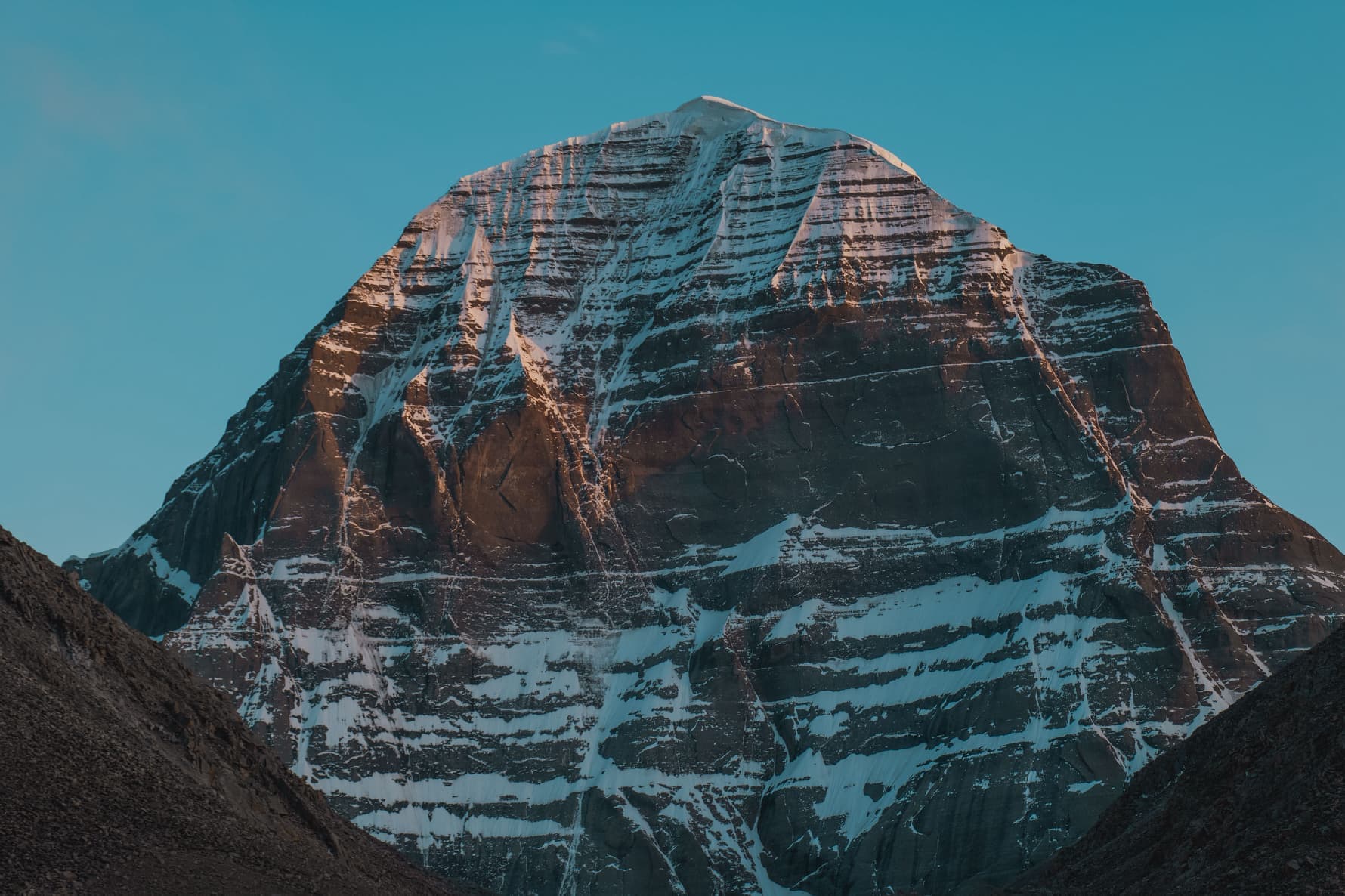
Mount Kailash: Map of the Circumambulation Around Kailash

Introduction to the Sacred Mountain Kailash

Mount Kailash is one of those peaks that attract not for its geographical height, but for its inner strength. For Buddhists, it is the abode of Buddha Chakrasamvara; for Hindus, it is the home of Shiva; for Jains, it symbolizes liberation. Each tradition sees its own image in it, but all agree on one thing: Kailash is a place where the physical world meets the spiritual.
Geographic and Climatic Conditions
Kailash stands at an altitude of 6,638 meters in Western Tibet. Surrounding it are plateaus, the Manasarovar and Rakshas Tal lakes, endless stony deserts, and thin air. In summer, daytime temperatures can reach +15 °C, while nights can drop below freezing. In winter, temperatures can plummet to –30 °C. The optimal time for circumambulation is from May to October when the passes are passable, and there is no risk of getting stuck in snowfall.
Honestly, the altitude is felt immediately. I recommend spending at least two or three days at an altitude of 3,500–4,000 m before starting the circumambulation. I have seen people who neglected acclimatization and experienced severe discomfort at the Dolma-La Pass (5,630 m). It's better to give your body time to adjust — this is not a sprint.
Preparation for the Circumambulation of Mount Kailash
The circumambulation is about 52 kilometers of walking around the mountain. Most people complete it in three days, although Tibetan pilgrims can do it in one day or make prostrations, stretching the circumambulation over weeks.
Basic checklist:
Physical Fitness
Regular hikes with a backpack, preferably in the mountains. If you live on flat ground, at least climb stairs or jog. The circumambulation does not require mountaineering skills, but endurance is necessary.
Equipment
Trekking boots (broken in!), a 40–50 L backpack, a sleeping bag rated for –10 °C (it can get cold in guesthouses), thermal underwear, a down jacket, a waterproof jacket, trekking poles, UV 400 sunglasses, and sunscreen with SPF 50+.
Food and Water
Energy bars, nuts, dried fruits, electrolytes. You can collect water from streams, but it's better to have a filter or purification tablets.
First Aid Kit
Diamox (acetazolamide) for acclimatization (consult a doctor), ibuprofen, blister plasters, antiseptic, and anti-diarrheal medications.
Documents
Tibet Travel Permit, Kailash permit (obtained through a travel agency), passport, Chinese visa, and medical insurance covering high altitudes.
Local customs: circumambulation is done clockwise (for Buddhists and Hindus), do not make noise, do not litter, and respect prayer flags and mani stones. The circumambulation is a dialogue with the mountain, not a checklist.
If you want more details, check the programs Kailash: Sacred Circumambulation from Lhasa or Kailash via Nepal: Circumambulation with Gosainkunda. They describe each day, logistics, and nuances that are hard to foresee on your own.
Map of the Circumambulation Route Around Kailash

The circumambulation is not just trekking; it's a rhythm you need to enter. Let's look at the route day by day to give you a realistic idea of what to expect.
Detailed Description of the Circumambulation Route: Distance, Travel Time
Day 1: Darchen — Dirapuk (≈20 km, 6–8 hours)
Start in the village of Darchen (4,560 m). The first section is gentle, walking along the valley, gradually ascending. On the right is the western wall of Kailash, and on the left are hills and prayer flags. By evening, you reach the Dirapuk guesthouse (5,080 m) at the foot of the northern wall. You will spend the night here. In the evening, if the weather permits, you can climb a little higher — the sunrise on Kailash is unforgettable.
Day 2: Dirapuk — Dolma-La Pass — Zutulpuk (≈22 km, 8–10 hours)
The hardest day. The ascent to Dolma-La (5,630 m) takes 3–4 hours. Breathe evenly, take breaks every 50–100 meters. At the pass, you'll find Gauri Kund Lake (often frozen), hundreds of prayer flags, and stones with notes from pilgrims. The descent is steep, putting a strain on the knees — poles can help. By evening, you will arrive at Zutulpuk (4,790 m), where there is again a guesthouse.
Day 3: Zutulpuk — Darchen (≈14 km, 4–5 hours)
A gentle descent along the river valley. The landscapes change — green patches appear, and yaks graze. By lunchtime, you return to Darchen. The circumambulation is completed.
Visualization of the Map with Key Points
On paper maps sold in Darchen, you will usually find:
- Chorten Kangni (flagpole) — the official starting point
- Dirapuk Gompa — monastery at the northern wall
- Dolma-La Pass — the highest point
- Gauri Kund Lake — sacred lake at the pass
- Zutulpuk Gompa — cave monastery
- Drinking Water Sources (streams are available, but not everywhere)
I always recommend having both a paper map and a GPS track (Maps.me, Gaia GPS) — the signal is not available everywhere, but offline maps work.
How to Obtain an Up-to-Date Map on Site
In Darchen, there are several shops that sell schematic maps of the circumambulation (usually 20–50 yuan). The quality is average, but the main landmarks are indicated. The best option is to ask your guide or the agency organizing your trip for a map. Local Tibetans can also offer advice, but the language barrier may complicate communication.
In our groups, we always have verified tracks and detailed briefings before starting — this is part of the preparation. Details can be found in the programs Kailash: Sacred Circumambulation from Lhasa and Kailash via Nepal: Circumambulation with Gosainkunda.
Preparing for the Journey: What to Bring

Packing a backpack for Kailash is an art in itself. You need to take enough to avoid freezing and starving but not overload yourself at high altitude.
Checklist of Essential Items
Clothing:
— Thermal underwear (top + bottom, preferably wool or synthetic)
— Fleece jacket or lightweight down jacket
— Down jacket (for the evening and the pass)
— Membrane jacket and pants (to protect against wind and rain)
— Trekking pants, convertible if possible
— Hat, buff, gloves (thin and warm)
— Trekking boots (broken in!) + sandals for the guesthouse
— Spare socks (2–3 pairs of wool)
Equipment:
— 40–50 L backpack (if you carry everything yourself) or 20–30 L (if there are porters/yaks)
— Sleeping bag rated for –10 °C (guesthouse blankets are often dirty and cold)
— Trekking poles
— Headlamp + spare batteries
— Thermos (tea at the pass is a lifesaver)
— UV category 4 sunglasses, SPF 50+ sunscreen, lip balm
Medications:
— Diamox (acetazolamide) — as prescribed by a doctor
— Ibuprofen, paracetamol
— Loperamide (for diarrhea)
— Rehydration salts or electrolytes
— Blister plasters, elastic bandage
— Antiseptic, chlorhexidine
— Personal prescription medications
Food:
— Energy bars, nuts, dried fruits, chocolate
— Freeze-dried food (if you plan to cook yourself)
— Water purification tablets or a filter
Recommendations for Acclimatization and Physical Preparation
Acclimatization:
Spend at least 2–3 days at an altitude of 3,500–4,000 m before starting the circumambulation. Lhasa (3,650 m) is a great option. Drink plenty of water (3–4 liters per day), avoid alcohol and heavy food. Ascend gradually: "climb high, sleep low." If you experience severe headache, nausea, or shortness of breath at rest — descend, don’t be a hero.
Physical Preparation:
2–3 months before the trip:
— Walk with a backpack (10–15 kg) 2–3 times a week, gradually increasing the distance
— Ascents in the mountains or stairs
— Cardio: running, cycling, swimming — for endurance
— Stretching and yoga — for flexibility and injury prevention
Tips for Choosing the Right Group for the Trek
Experience of Organizers:
Find out how many times the team has led groups to Kailash. Check reviews, talk to those who have already been. An experienced guide knows not only the route but also how to help with altitude sickness, where to find a doctor, and how to solve permit issues.
Group Size:
Ideally, 6–10 people. Fewer means higher costs per person, more makes coordination harder and slows the pace.
Support:
Clarify whether there are porters or yaks in the group, a cook, a first aid kit, and oxygen tanks in case of emergency.
Atmosphere:
The circumambulation is not just physical; it’s also about the inner attitude. It’s great when the group consists of people focused on mindfulness rather than rushing for photos.
At Jay Shambo, we strive to create just such an atmosphere — respect for the place, for oneself, and for companions.
Safety During the Circumambulation

Kailash is not an extreme route in the classic sense, but there are risks. Let’s discuss the main ones and how to minimize them.
Main Risks: Altitude, Weather, Health
Altitude:
Altitude sickness (AMS) is the main threat. Symptoms include headache, nausea, weakness, insomnia, and loss of appetite. Severe forms (HAPE, HACE) can be fatal. Prevention: slow ascent, ample hydration, Diamox (as prescribed by a doctor). If symptoms worsen — descend immediately.
Weather:
Even in summer, it can snow at the pass, with temperatures dropping to –10 °C, and winds can knock you down. Check the forecast, but be prepared for surprises. Always carry a warm layer and rain gear.
Health:
Stomach issues from unfamiliar food or water are common problems. Injuries: strains, blisters, frostbite. Dehydration and sunburn at altitude happen faster than you might think.### How to Avoid Problems and What to Do in Emergency Situations
Prevention:
— Don’t rush. It's better to go slowly and arrive than to hurry and break down.
— Listen to your body. If you feel unwell, inform your guide immediately.
— Drink water regularly, even if you’re not thirsty.
— Eat calorie-dense food, even if you don't have an appetite.
— Dress appropriately for the weather; avoid overheating or getting too cold.
Emergency Situations:
— In case of severe altitude sickness — immediate descent. If you don’t have the strength to walk, call for help (the guide has communication).
— In case of injury — first aid on the spot, evacuation by yak or stretcher to Darchen, then a vehicle to the nearest hospital (Ali or back to Nepal/Lhasa).
— Oxygen tanks are available in some guesthouses and with organized groups — don’t hesitate to ask.
Contact Information for Local Services and the Guide
Group Guide:
Before starting, save your guide's phone number in your phone. A Chinese SIM card works in Tibet, but the signal along the route can be weak or nonexistent.
Emergency Services:
There is a small clinic in Darchen (basic assistance). Serious cases are evacuated to Ali (300 km) or back to Kathmandu/Lhasa. Emergency phone number in China: 120, police: 110. In practice, it's faster to contact through the guide or local residents.
Communication:
Mobile service is available in Darchen and partially on the first section of the kora. Beyond the pass — only satellite communication (if available). I recommend having a satellite phone or GPS tracker with SOS function in the group (like Garmin InReach).
Insurance:
Mandatory. Make sure it covers altitude up to 6,000 m, helicopter evacuation (although helicopters are rare around Kailash, it’s better to be safe), and medical expenses in China/Nepal.
Safety is not paranoia; it’s respect for the mountain and for yourself. If you are prepared, Kailash will greet you calmly.
Budget for a Trip Around Kailash

A trip to Kailash is a significant expense. Let's break down the main costs and ways to optimize your budget without sacrificing comfort and safety.
Expenses for Transportation, Accommodation, Food, and Permits
Transportation:
— Air Tickets: Moscow — Kathmandu (via Delhi, Doha, or Istanbul) — from 35,000 to 60,000 ₽ round trip, depending on the season and how far in advance you book. Moscow — Lhasa (via Beijing/Chengdu) — from 40,000 to 70,000 ₽.
— Ground Transfer: From Kathmandu to the Tibet border (Kerung) + further to Kailash — about 15,000–25,000 ₽ per person (in a group, by jeep). From Lhasa to Kailash — approximately 20,000–30,000 ₽ (4–5 days by jeep round-trip).
Accommodation:
— Guesthouses on the kora: 1,000–2,000 ₽ per night (basic conditions: bunks, shared toilet, often no shower).
— Hotels in Lhasa/Kathmandu: 2,000–5,000 ₽ per night (mid-range).
— Tents: If you bring a tent (rare on the kora, as there are guesthouses) — you save on accommodation but carry extra weight.
Food:
— On the kora: 800–1,500 ₽ per day (tea, noodles, rice, momo in guesthouses; the variety is modest).
— In Lhasa/Kathmandu: 1,500–3,000 ₽ per day (you can eat cheaper in local cafes and more expensive in tourist restaurants).
Permits and Visas:
— Tibet Travel Permit: ~100 USD (~9,000 ₽), arranged through an agency.
— Alien's Travel Permit (for Kailash): ~50 USD (~4,500 ₽).
— Chinese Visa: ~100 USD (~9,000 ₽), arranged in advance.
— Nepalese Visa: ~50 USD (~4,500 ₽), available on arrival.
Total for visas and permits: ~27,000 ₽.
Other:
— Guide and Organization: Independent travel to Tibet is not allowed — you need an accredited tour company. The cost of an organized tour (excluding international flights) ranges from 120,000 to 250,000 ₽ per person, depending on the route, group size, and service level.
— Insurance: ~5,000–10,000 ₽ (coverage up to 6,000 m, evacuation).
— Equipment: If you are starting from scratch — an additional 30,000–50,000 ₽ (boots, down jacket, sleeping bag, backpack, etc.).
Price Comparison for Different Routes (Through Nepal and Lhasa)
Route through Nepal (Kathmandu — border — Kailash):
— Pros: visa on arrival, easier acclimatization (you can trek in the Himalayas), cheaper to start.
— Cons: the road from the border to Kailash is long and bumpy, less time for adaptation in Tibet itself.
— Approximate tour cost: 130,000–180,000 ₽ (excluding international flight).
Route through Lhasa:
— Pros: better acclimatization (2–3 days in Lhasa), you can visit Potala, Jokhang, and other monasteries, picturesque road through the Changthang plateau.
— Cons: longer, more expensive, need a Chinese visa in advance.
— Approximate tour cost: 150,000–250,000 ₽ (excluding flight).
How to Save on Travel Without Losing Quality
1. Book flights in advance.
Prices are lower 3–6 months ahead. Keep an eye on sales, use aggregators, and flexible dates.
2. Join group tours.
An individual tour to Kailash can cost twice as much. Group trips share transport, guide, and permits among all.
3. Choose the right season.
Peak season (July–August) is more expensive and crowded. May, June, and September offer more accessible prices and fewer pilgrims.
4. Rent equipment.
In Kathmandu and Lhasa, you can rent sleeping bags, down jackets, and trekking poles. It’s cheaper than buying if you’re only going once.
5. Eat at local establishments.
Momo, thukpa, and tea in Tibetan teahouses are delicious, filling, and significantly cheaper than tourist restaurants.
6. Don't skimp on health and safety.
Good insurance, a reliable guide, quality boots — these are not areas to cut costs. An injury or evacuation will cost you more.
If you want reliable organization and a transparent budget, check out our programs Kailash: Sacred Kora from Lhasa and Kailash via Nepal: Kora with Gosainkunda. Everything is detailed to the last ruble, with no hidden fees.
FAQ

What does Kailash Kora mean?
The word "kora" (Tib. སྐོར་ར) means "ritual circumambulation of a sacred object in a clockwise direction." For Buddhists and Hindus, Kailash is the axis of the world, the abode of deities, the center of the universe. Each circle around the mountain is an act of reverence, a cleansing of negative karma, a step on the path to liberation.
The kora around Kailash is 52 kilometers through passes, prayer flags, mountain rivers, and inner silence. Tibetan pilgrims believe that 108 koras liberate one from samsara. Even a single kora changes a person — I have seen this in our groups. People arrive with questions and leave with answers. Not always in words — more often with clarity.
How to Trek to Mount Kailash?
Preparation:
Physical Condition
Start preparing 2–3 months in advance: hiking with a backpack, ascending mountains, cardio. The kora doesn’t require mountaineering skills, but it does require endurance. If you have chronic conditions, consult a doctor.
Documents
You cannot enter Tibet independently — you need an accredited tour company to arrange the Tibet Travel Permit and Alien's Travel Permit. The Chinese visa must be arranged in advance (if you’re going through Lhasa), the Nepalese visa can be obtained on arrival (if you’re going through Kathmandu).
Acclimatization
Spend at least 2–3 days at an altitude of 3,500–4,000 m before starting. In Lhasa or Kathmandu. Don’t ignore this stage — altitude sickness is no joke.
Route:
Day 1: Darchen —